AI-Native Industrial Robot Arms
- Exponential Industry
- Technology Area
- 16 Milestones
Multi-axis articulated robotic arms and collaborative manipulators driven by real-time vision-language-action (VLA) foundation models rather than rigid teach-pendant G-code scripting. Systems pair precision multi-joint kinematics with continuous neural feedback to execute adaptive pick-and-place, precision fastening, and non-destructive inspection. Commercial deployment spans established OEM leaders like FANUC and KUKA alongside AI-native integrators like THEKER and Physical Intelligence.
Exponential Industry · Hidden Factory
AI-Native Industrial Robot Arms
1X and Universal Robots plan Yocto JetPack 7.2 production
1X (Neo Humanoid) and Universal Robots are planning to adopt Yocto-based JetPack 7.2 in production deployments /NVIDIA Blog/.
SGMW I²MS Named National Pioneering Intelligent Factory
China MIIT designated the SGMW Intelligent Island Manufacturing System (I²MS) as a National Pioneering Intelligent Factory, the sole automotive manufacturing recipient in the inaugural cohort /General Motors China News/ /ASSEMBLY Magazine/.
GM / 3M / FANUC moving-line robotic paint repair
First robotic paint-finishing solution on a moving automotive line: FANUC M-710iC/70, 3M Finesse-it, Inovision SMARTInspect /FANUC America/.
Dürr first BYD passenger-car paint shop (Szeged, 2025)
Dürr's first passenger-car order from BYD: 120+ EcoRP robots with EcoBell3 atomizers for BYD's first European plant in Szeged /Dürr/.
Magna MARS smart bin-picking
Magna reports 40+ MARS smart robotic cells in use /Magna/.
Blue QDD arm paper (arXiv / ICRA 2019)
Gealy et al. publish Quasi-Direct Drive for Low-Cost Compliant Robotic Manipulation; 6-page version accepted to ICRA 2019 /arXiv/.
GM Lordstown Unimate spot-welding line
1969 Lordstown rebuild with Unimate welders at 110 cars/hr. IEEE separately dates a 28-robot spot-weld line to 1970 and later labor conflict /Automate.org / Association for Advancing Automation/ /IEEE Spectrum/.
Kawasaki–Unimation Unimate license
Kawasaki partnership announced October 1968; first Kawasaki-Unimate 2000 completed 1969. Automate.org dates the license 1969 /IEEE Spectrum/ /Automate.org / Association for Advancing Automation/.
Trallfa paint robot first production
Ole Molaug Trallfa spray-paint robot enters production; first robotic paint automation in industrial automotive manufacturing (later ABB) /cyberneticzoo.com/.
Unimate on The Tonight Show
Engelberger demonstrates Unimate on The Tonight Show with Johnny Carson (Automate.org 1966; IEEE also recounts beer-can and band bits) /Automate.org / Association for Advancing Automation/ /IEEE Spectrum/.
First Unimate installed at GM
First Unimate industrial robot installed at GM Ternstedt, Trenton, N.J., unloading a die-cast press (IEEE Spectrum / The Henry Ford) /cyberneticzoo.com/ /IEEE Spectrum/ /The Henry Ford/ /Automate.org / Association for Advancing Automation/.
Unimation Inc. established in Danbury
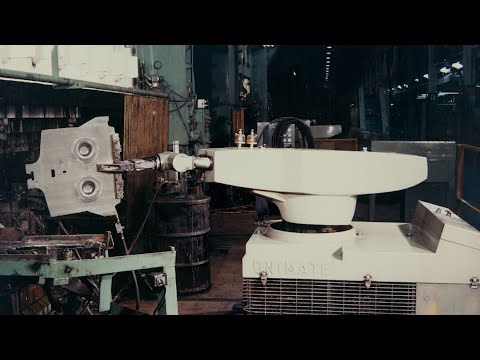
Engelberger established Unimation, Inc., a Condec company in Danbury, in 1961; Unimate 1900 becomes the first mass-produced factory arm /Automate.org / Association for Advancing Automation/ /The Henry Ford/.
Condec purchases Unimation
Condec purchased Unimation in 1960 and bought Devol’s patent when issued in 1961 /IEEE Spectrum/.
Unimate #001 prototype at GM Trenton
2,700 lb Unimate #001 prototype installed on a GM die-casting line in Trenton (distinct from the 1961 production install in IEEE/museum) /Automate.org / Association for Advancing Automation/.
Devol and Engelberger meet; Unimation founded
George Devol and Joseph Engelberger meet at a 1956 cocktail party and shortly afterward found Unimation (IEEE Spectrum) /IEEE Spectrum/ /Automate.org / Association for Advancing Automation/.
Pollard Jr. files spray-painting machine patent
US2213108 filed; granted 1940-08-27. Film-programmed pantograph spray painter /USPTO / Google Patents/.
Frequently Asked Questions
What is AI-Native Industrial Robot Arms and what industrial engineering problems does it address?
Multi-axis articulated robotic arms and collaborative manipulators driven by real-time vision-language-action (VLA) foundation models rather than rigid teach-pendant G-code scripting. Systems pair precision multi-joint kinematics with continuous neural feedback to execute adaptive pick-and-place, precision fastening, and non-destructive inspection. Commercial deployment spans established OEM leaders like FANUC and KUKA alongside AI-native integrators like THEKER and Physical Intelligence.
What core technologies and manufacturing architectures comprise AI-Native Industrial Robot Arms?
Key technical architectures and manufacturing innovations include:
- Unimate: First production industrial robot; GM Ternstedt/Trenton die-cast unload (IEEE/museum 1961; Automate.org also cites a 1959.
- 3M Finesse-it Robotic Paint Repair: AI-driven sand-and-polish system that issues real-time recipes for paint defects on a moving vehicle line.
- Magna Advanced Robotics Software (MARS): 3D-camera plus AI bin-picking software; 40+ smart cells in Magna plants; claimed up to 40% shorter product launch.
- SGMW Intelligent Island Manufacturing System (I²MS): World's first island-based automotive manufacturing system replacing linear assembly lines with flexible AI-driven assembly islands, AGV logistics, and EOAI operations model. Claims ~30% efficiency gain, 31% unit cost cut, 43% shorter product development cycle, 50% automation in general assembly (34 unmanned islands).
- NVIDIA JetPack 7.2: Jetson software stack (OS, compute, deterministic performance). 7.2 adds agentic AI skills, Yocto-based OS, CUDA 13 on Jetson Orin, a 241 TOPS AGX Orin 32GB boost, and MIG on Jetson Thor.
- 1X Neo: 1X humanoid robot. NVIDIA Blog 2026-06-01: 1X (maker of the Neo Humanoid) is planning to adopt Yocto-based JetPack 7.2 in production deployments.
Which companies and industrial facilities lead deployment in AI-Native Industrial Robot Arms?
Leading industrial manufacturers, hyperscalers, and engineering operators include:
- General Motors: GM Lordstown Unimate spot-welding line (1969) — In 1969, it rebuilt its Lordstown, Ohio plant installing Unimate spot welding robots. Capable of production speed never before achieved, the robots built 110 cars per hour.
- Unimation: First Unimate installed at GM (1961) — 1961 – 1st "Unimate", installed at GM.
- Trallfa: Trallfa paint robot first production (1967) — 1965-7 – Ole Molaug developed his Trallfa spray-paint robot. First production run in 1967. Now ABB.
- Condec Corp.: Unimation Inc. established in Danbury (1961) — In 1961 Engelberger established Unimation, Inc., a Condec Corp. company in Danbury, Connecticut.
- Kawasaki Heavy Industries: Kawasaki–Unimation Unimate license (1968) — In June 1968, Kawasaki Aircraft opened its Office for Promoting Domestic Production of Industrial Robots, and the following October it announced a partnership with Unimation. The first Kawasaki-Unimate 2000 was completed in 1969 and cost 12 million yen per unit.
- SAIC-GM-Wuling: SGMW I²MS Named National Pioneering Intelligent Factory (Nov 27, 2025) — SAIC-GM-Wuling (SGMW) today announced that its Intelligent Island Manufacturing System (I²MS) has been recognized as the Pioneering Intelligent Factory, the nation's highest honor in intelligent manufacturing sector. SGMW is among the first group to receive the top-level recognition and the only manufacturer in the automotive industry.
What are key commercial projects and milestone achievements in AI-Native Industrial Robot Arms?
Major industrial breakthroughs and commercial milestones include:
- First Unimate installed at GM (1961): 1961 – 1st "Unimate", installed at GM.
- Unimation Inc. established in Danbury (1961): In 1961 Engelberger established Unimation, Inc., a Condec Corp. company in Danbury, Connecticut.
- Trallfa paint robot first production (1967): 1965-7 – Ole Molaug developed his Trallfa spray-paint robot. First production run in 1967. Now ABB.
- GM Lordstown Unimate spot-welding line (1969): In 1969, it rebuilt its Lordstown, Ohio plant installing Unimate spot welding robots. Capable of production speed never before achieved, the robots built 110 cars per hour.
- GM / 3M / FANUC moving-line robotic paint repair (Jan 15, 2025): GM improved paint finish consistency and reduced costs by automating top‑coat inspection and repair using FANUC robots and 3M’s AI‑driven system.
- SGMW I²MS Named National Pioneering Intelligent Factory (Nov 27, 2025): SAIC-GM-Wuling (SGMW) today announced that its Intelligent Island Manufacturing System (I²MS) has been recognized as the Pioneering Intelligent Factory, the nation's highest honor in intelligent manufacturing sector. SGMW is among the first group to receive the top-level recognition and the only manufacturer in the automotive industry.
Related Technology Ontologies
Physical AI & Embodied Robotics
Artificial intelligence systems and autonomous machines that operate directly in and interact with the physical world, bridging bits to atoms. Spanning foundation models (Vision-Language-Action and World Foundation Models), physics-based simulation with synthetic data (Omniverse, Isaac Sim) to safely bridge Sim2Real, and embedded runtime computers (Jetson Thor, DRIVE AGX) executing closed-loop perception-action loops across humanoids, AMRs, adaptive manipulators, autonomous mobility, and smart spaces.
Data Center Power & Behind-the-Meter Generation
Generation and storage sited at or next to AI/cloud campuses so the load does not wait on a transmission queue. Common stacks pair gas turbines or engines with on-site BESS; some designs add behind-the-meter solar. Hyperscalers and developers announced multi-hundred-megawatt gas+BESS campuses in 2025–2026 to serve rack-scale AI halls.
Rackscale AI Accelerators
Fully co-designed rack- and POD-scale AI systems that combine accelerators, host CPUs, scale-up fabric (NVLink-class domains), and scale-out networking in one thermal/mechanical package. Lineage runs from multi-GPU HGX/DGX boxes through Grace Hopper NVL32 domains to liquid-cooled 72-GPU racks (GB200, GB300, Vera Rubin) and competing racks such as AMD Helios. NVIDIA, AMD, and OEM rack builders (Dell, Supermicro) ship the current generation for AI-factory halls.