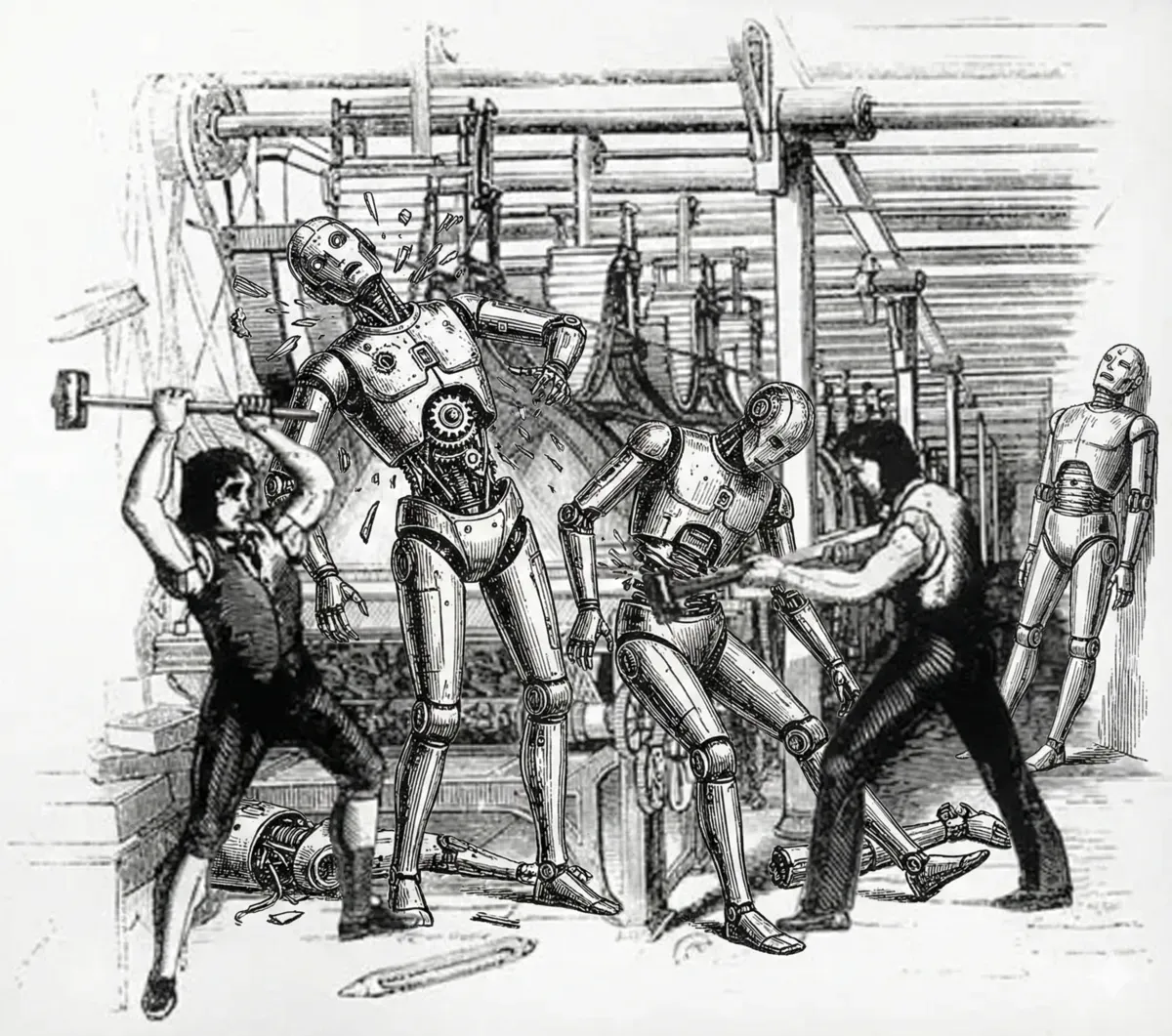
References Behind The Machine-breaking Disturbances Rocking Assembly
- David Rogers
- 2026-02-01
The headline “The Machine-breaking Disturbances Rocking Assembly” isn’t just a dramatic title, it’s a direct historical callback to the Luddite Riots of 1811. As Hyundai’s South Korean union warns of “employment shocks” from humanoid robots, we are seeing the 19th-century ghost of Ned Ludd enter the modern factory floor.
Read the digest here.
Why the “Machine-breaking” Reference?
The term refers to the Luddites, textile workers in 19th-century Britain who were enduring economic upheaval and widespread unemployment.
One technology the Luddites commonly attacked was the stocking frame, a knitting machine first developed more than 200 years earlier by an Englishman named William Lee. Right from the start, concern that it would displace traditional hand-knitters had led Queen Elizabeth I to deny Lee a patent. Lee’s invention, with gradual improvements, helped the textile industry grow—and created many new jobs. But labor disputes caused sporadic outbreaks of violent resistance. Episodes of machine-breaking occurred in Britain from the 1760s onward, and in France during the 1789 revolution. — Richard Conniff for the Smithsonian Magazine
- The Myth: They followed “General Ned Ludd,” a mythical figure said to live in Sherwood Forest.
- The Action: They didn’t just protest; they smashed the wide weaving frames with sledgehammers and engaged in skirmishes with government soldiers.
- The Stakes: At one point, Britain deployed around 12,000 British troops (including regular army, militia, and yeomanry) across the affected regions (mainly Nottinghamshire, Yorkshire, and Lancashire) to suppress Luddite activity during its peak in 1811–1813.
Why This Matters Now
As Ethan Mollick and other observers note, Industrial Revolutions generally “work out” in the long run, but they are brutal to live through. Hyundai’s plan to manufacture 30,000 robots annually by 2028 represents a shift from advanced but costly automation to full human replacement tech.
“Remember that without labour–management agreement, not a single robot using new technology will be allowed to enter the workplace.” — Hyundai Union Letter
The “Assembly” isn’t just the car plant, it’s the assembly of a new social contract. The Luddites were skilled artisans fighting for livelihoods amid economic hardship worsened by war and mechanization, and the government’s harsh response highlighted how serious technological change impacts societal order.
They confined their attacks to manufacturers who used machines in what they called “a fraudulent and deceitful manner” to get around standard labor practices. “They just wanted machines that made high-quality goods,” says Binfield, “and they wanted these machines to be run by workers who had gone through an apprenticeship and got paid decent wages. Those were their only concerns.” — Richard Conniff for the Smithsonian Magazine