Concrete Role in AI Shells
- David Rogers
- 2026-05-31
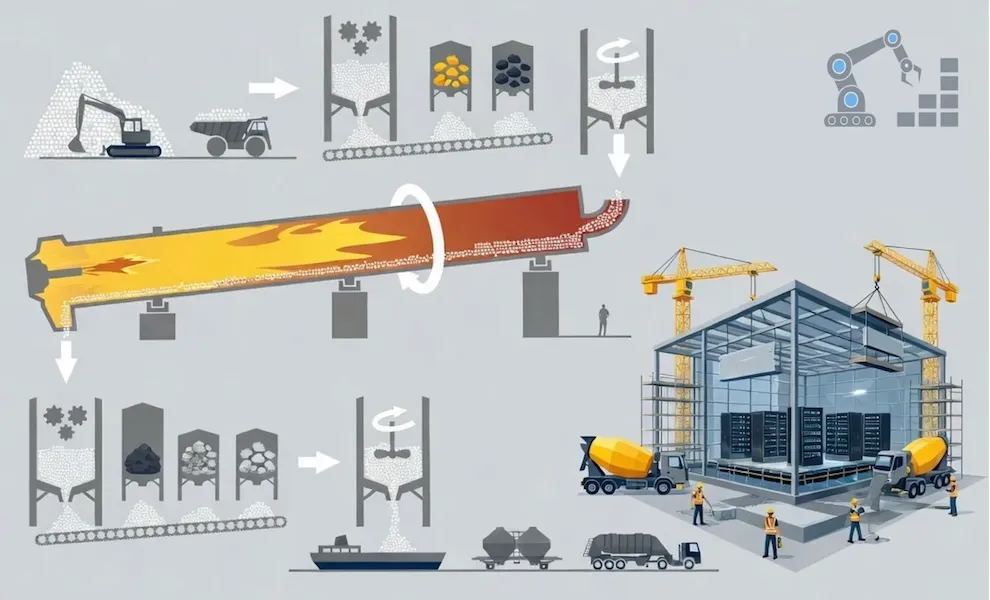
Concrete constitutes the primary structural material forming the physical shell of AI data centers. This encompasses the thick foundations, floor slabs, and supporting elements needed to accommodate dense arrays of GPUs, liquid cooling infrastructure, power distribution systems, and extensive cabling. These requirements correspond to the physical infrastructure component identified in established models of the AI five layer cake. According to projections from the American Cement Association, construction of AI data centers in the United States will require approximately one million metric tons of cement through 2028, highlighting the considerable material volumes associated with current hyperscale development.
Concrete production today follows a standardized industrial sequence that begins with raw material extraction and concludes with a finished product suitable for structural applications, as documented in the BuildWitt video on concrete manufacturing. Limestone and aggregates are first extracted from quarries and subjected to staged crushing operations to achieve consistent particle sizes. The materials are then washed to remove impurities and blended with iron, silica, and alumina before being introduced into rotary kilns operating at approximately 2,700°F. Within the kilns, chemical reactions produce clinker nodules, which are subsequently cooled and ground into cement powder for use in concrete mixes.
Technologies are being developed to enhance the formulation, production, and placement of concrete for AI data center projects. The open-source BOxCrete framework from Meta Engineering, available through the SustainableConcrete repository on GitHub, applies optimization techniques to refine mix designs based on historical performance data. In collaboration with Amrize and the University of Illinois at Urbana-Champaign, this approach yielded a domestically sourced concrete mix for a data center project in Minnesota that attained full structural strength 43 percent faster and exhibited reduced cracking compared with conventional formulations. Hybrid cement production systems integrate electric induction heating elements into conventional kiln operations, enabling the use of grid electricity during periods of lower cost while retaining the option to utilize traditional fuels. On construction sites, autonomous drilling systems developed by DEWALT in partnership with August Robotics perform precision anchor hole installation in cured concrete at accelerated rates and with high positional accuracy, contributing to reduced overall project durations in multiple hyperscale facilities.
The concentration of proposed AI data center projects in established clusters such as Northern Virginia, Texas, Arizona, Georgia, and Illinois will generate intense localized demand for concrete that exceeds current regional production levels in many areas. Concrete and its primary components remain economically and logistically constrained by transportation distances, making expanded cement manufacturing capacity, aggregate extraction, and ready-mix operations essential near these development zones to support timely delivery for extensive foundation and slab placements. Without targeted increases in nearby production infrastructure, the buildout risks supply bottlenecks, higher material costs, and extended construction schedules that could impede the pace of AI infrastructure deployment.