Satellite Structural Lightweighting
- Exponential Industry
- 9 Milestones
Structural mass reduction and volume optimization of commercial satellites through carbon-fiber composites, generative lattice additive manufacturing, and ultra-low-density polymer aerogels. Minimizing structural dry mass directly reduces launch costs while maximizing orbital delta-V, onboard propellant, and flat-packed constellation stack density. Key engineering adopters include SpaceX Starlink, NASA Glenn Research Center, Kerberos Engineering, and Rock West Composites.
Readiness Assessment: CFRP structures, honeycomb sandwiches, and topology-optimized AM parts are operational on commercial and government satellites. Newer coatings (MXene), aerogel apertures, and DiskSat form factor are earlier.
Active Satellite Structural Lightweighting Engineering Roles
Explore verified engineering requisitions ($135,000 – $235,000+) with unredacted direct apply URLs and verified corporate alumni networks on Scholar.


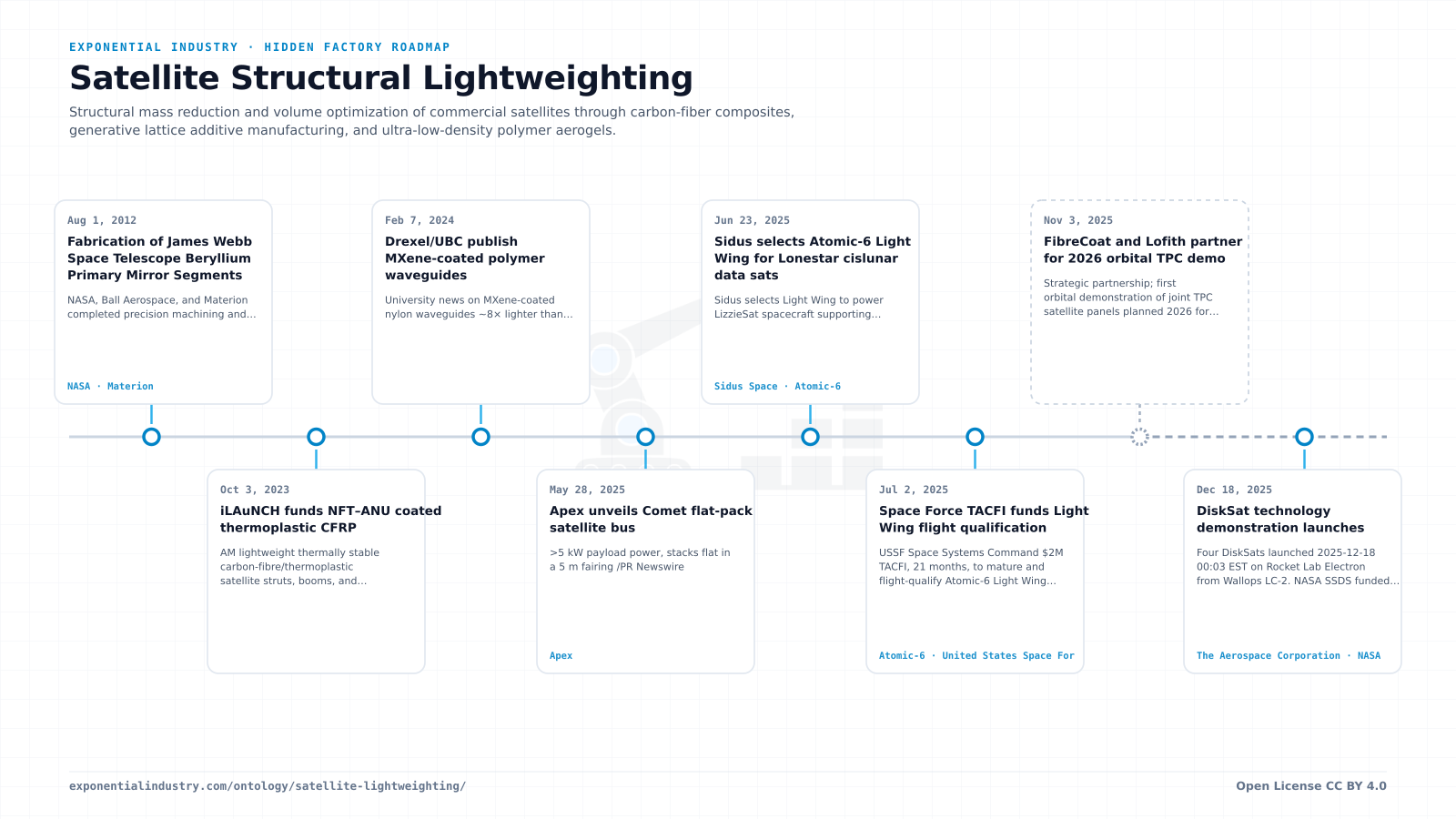
DiskSat technology demonstration launches
Four DiskSats launched 2025-12-18 00:03 EST on Rocket Lab Electron from Wallops LC-2. NASA SSDS funded development; USSF RSLP/STP funded launch and ops /NASA/.
FibreCoat and Lofith partner for 2026 orbital TPC demo
Strategic partnership; first orbital demonstration of joint TPC satellite panels planned 2026 for ~12 months (article: expected Q1–Q2 2026) /CompositesWorld/.
Space Force TACFI funds Light Wing flight qualification
USSF Space Systems Command $2M TACFI, 21 months, to mature and flight-qualify Atomic-6 Light Wing (coupon, cell compatibility, TVAC, vibe) /PR Newswire / Atomic-6/.
Sidus selects Atomic-6 Light Wing for Lonestar cislunar data sats
Sidus selects Light Wing to power LizzieSat spacecraft supporting Lonestar’s cislunar data-storage constellation under an expanded $120M preliminary agreement /Sidus Space / Business Wire/.
Apex unveils Comet flat-pack satellite bus
>5 kW payload power, stacks flat in a 5 m fairing /PR Newswire / Apex Space/.
Drexel/UBC publish MXene-coated polymer waveguides
University news on MXene-coated nylon waveguides ~8× lighter than aluminum for satellite microwave hardware /Drexel University/.
iLAuNCH funds NFT–ANU coated thermoplastic CFRP
AM lightweight thermally stable carbon-fibre/thermoplastic satellite struts, booms, and reflectors with AO/radiation coatings /iLAuNCH Trailblazer/.
Thales Alenia Space takes AM brackets into series production
Series AM Al/Ti reaction-wheel and ADPM antenna brackets on Spacebus Neo. First four parts already on Eutelsat Konnect /Thales Alenia Space/.
Fabrication of James Webb Space Telescope Beryllium Primary Mirror Segments
NASA, Ball Aerospace, and Materion completed precision machining and cryogenic testing of 18 O-30 optical-grade beryllium primary mirror segments for the James Webb Space Telescope /NASA Technical Reports Server/ /Materion Corporation/.
Core Architectures, Physical Parameters & Commercial Implementers
Our ontology tracks 14 primary architectures, hardware platforms, and material systems implementing Satellite Structural Lightweighting.
Trunk & Competing Technology Branches
Incumbent Trunks vs. Challenger & Emerging PathwaysGrid-Stiffened Lattice, Cellular CFRP & Thermoplastic Space Structures
Ultra-low-areal-density carbon-fiber lattice cylinders, spread-tow TeXtreme solar arrays, and thermoplastic composite sandwich panels for spacecraft primary buses and deployable wings.
TRL Grounding: TRL 8–9 flight heritage across LEO constellations and exploration missions (Atomic-6, Rock West, PMT, ATG, Kerberos).
Topology-Optimized Additive Metallic Brackets & Polymer-Metallized RF Guides
Laser powder-bed fused AlSi10Mg/Ti64 topology-optimized satellite brackets and MXene/metallized polymer RF waveguides replacing machined aluminum blocks.
TRL Grounding: TRL 9 flight heritage on Thales Alenia Space geostationary/LEO satellites; TRL 5–7 for MXene waveguides.
| Architecture / System | Class & TRL | Technical Mechanism & Specifications | Commercial Implementers & OEMs |
|---|---|---|---|
| Atomic-6 Light Wing
Implements: Grid-Stiffened Lattice, Cellular CFRP & Thermoplastic Space Structures | product · TRL 6 Pilot Line Validation | All-composite redeployable solar array (Space Mast, Space Hinge, Light Sheet substrates). Vendor: up to 200 W/kg and >4× power per kg vs existing arrays. TRL 6 Grounding: USSF TACFI (2025-07-02) funds 21-month coupon, TVAC, and vibe flight qualification. Not yet described as on-orbit. | Atomic-6 Deployed with: Sidus Space |
| Thales Alenia Space AM satellite brackets
Implements: Topology-Optimized Additive Metallic Brackets & Polymer-Metallized RF Guides | product · TRL 9 Commercial Scale | Powder-bed 3D-printed aluminum and titanium reaction-wheel and ADPM antenna brackets. TAS: reaction-wheel bracket ~30% lighter and ~10% cheaper. TRL 9 Grounding: Series production on Spacebus Neo as of 2019-03-21; first four parts integrated on Eutelsat Konnect. | Thales Alenia Space |
| Apex Comet | product · TRL 7 Field Prototype | Flat-pack satellite bus: >5 kW continuous payload power, stacks in a 5 m fairing for constellation packing. TRL 7 Grounding: Productized bus announced 2025-05-28; Apex Aries already one year on orbit. Comet itself not claimed on orbit in that PR. | Apex |
| DiskSat | product · TRL 7 Field Prototype | 1 m diameter × 2.5 cm plate-shaped smallsat. Aluminum honeycomb core with carbon-fiber face sheets; stacks in a dispenser as a CubeSat alternative with more area/power at low structural mass. TRL 7 Grounding: Four-spacecraft demo launched 2025-12-18 on Rocket Lab Electron (NASA/Aerospace/USSF). | The Aerospace Corporation |
| Beryllium & Al-Be Additive Manufacturing and Precision Optics | process · TRL 6 Pilot Line Validation | High-precision additive and powder metallurgy processing of pure beryllium and aluminum-beryllium alloys (AlBeMet AM162/AM140, Beralcast) delivering extreme specific stiffness and cryogenic dimensional stability for aerospace structures and space telescope optics, requiring strict containment against Chronic Beryllium Disease (CBD) toxicity. TRL 6 Grounding: Demonstrated on specialized laser powder bed fusion (L-PBF) and hot isostatic pressing (HIP) systems with closed glovebox atmospheric containment. | Materion |
| New Frontier coated thermoplastic CFRP
Implements: Grid-Stiffened Lattice, Cellular CFRP & Thermoplastic Space Structures | capability · TRL 4 Lab / Pouch Validation | Automated carbon-fibre/thermoplastic structures with nanomaterial coatings for radiation and atomic-oxygen resistance. TRL 4 Grounding: iLAuNCH 2023 project to develop and validate coatings and AM composite struts/booms/reflectors; no flight claim in the release. | New Frontier Technologies |
| PMT Apex CFRP cellular core
Implements: Grid-Stiffened Lattice, Cellular CFRP & Thermoplastic Space Structures | product · TRL 6 Pilot Line Validation | Vented high-modulus CFRP cellular core from A&P QISO. PMT: one-tenth the cost of HM honeycomb at ultra-low CTE. Used with single-ply HexTow HM63 QISO skins (310 gsm vs 800 gsm eight-ply UD). TRL 6 Grounding: CompositesWorld 2025-07-28: manufactured and coupon/RF tested by RWC; full space qualification not claimed complete. | Patz Materials and Technologies Deployed with: Rock West Composites |
| Kerberos TeXtreme solar-array structure
Implements: Grid-Stiffened Lattice, Cellular CFRP & Thermoplastic Space Structures | product · TRL 7 Field Prototype | CFRP deployable solar-array substrates from ultra-thin TeXtreme 0/90 spread-tow (42 gsm dry) and VARTM. TRL 7 Grounding: CompositesWorld 2024-08-23: TeXtreme 0/90 used on deployable arrays; company cites prior on-orbit use. 90% figure is manufacturing resources, not mass. | Kerberos Engineering |
| FibreCoat AluCoat | product · TRL 6 Pilot Line Validation | Aluminium-coated fiber for composite EMI shielding and EV battery/structure use. Vendor: up to 80 dB shielding in composites; up to 25% weight vs conventional shielding. TRL 6 Grounding: Commercial mobility product page; ASTM D-4935 / CISPR-25 cited by the vendor. | FibreCoat |
| FibreCoat in-line coated fiber | process · TRL 6 Pilot Line Validation | Patented coating of metals or polymers onto fibers during spinning (30–100 kg/day per position). Aimed at EMI, radiation, heat, and mass for space, defense, and mobility. TRL 6 Grounding: Commercial production (3 sites, 42 staff as of Dec 2024). Space coupon demo with Lofith still planned 2026. | FibreCoat |
| Hoffmann injection-molded PEEK CubeSat structure | product · TRL 6 Pilot Line Validation | Injection-molded CubeSat primary structure from PEEK / space-qualified polymer. Hoffmann: ≥20% lighter than standard aluminum, with integrated SMA unlocking mechanisms. TRL 6 Grounding: Vendor product page describes an injection-molded CubeSat structure from space-qualified PEEK with SMA unlocks. | Kunststoffverarbeitung Hoffmann |
| Rock West Strato space structures
Implements: Grid-Stiffened Lattice, Cellular CFRP & Thermoplastic Space Structures | product · TRL 6 Pilot Line Validation | Off-the-shelf sandwich panels, plates, tubes, solar-array substrates, and reflectors aimed at high-volume smallsat production. TRL 6 Grounding: RWC combining PMT core + QISO into Strato panels/tubes/substrates; coupon tests reported 2025. | Rock West Composites |
| ATG grid-stiffened lattice composite
Implements: Grid-Stiffened Lattice, Cellular CFRP & Thermoplastic Space Structures | process · TRL 5 Lab / Pouch Validation | Uninterrupted unidirectional prepreg lattice / grid-stiffened cylinders. ÉireComposites: up to 35% mass vs sandwich; ~10 kg 1.5 m tube. Toray RS-36 tape. TRL 5 Grounding: 1.5 m satellite-central-tube demonstrator tested May 2019 (~10 kg, 17 t compression). Not described as flown. | ATG Europe |
| NASA aerogel phased-array antenna | product · TRL 5 Lab / Pouch Validation | Active phased-array antenna using polymer aerogel (~95% air) as the lightweight dielectric. Designed for SATCOM where power and volume are limited. TRL 5 Grounding: 2024 Navy aircraft flight test plus October 2024 ground GEO/LEO SATCOM links. | NASA |
Frequently Asked Questions
What is Satellite Structural Lightweighting and what industrial engineering problems does it address?
Structural mass reduction and volume optimization of commercial satellites through carbon-fiber composites, generative lattice additive manufacturing, and ultra-low-density polymer aerogels. Minimizing structural dry mass directly reduces launch costs while maximizing orbital delta-V, onboard propellant, and flat-packed constellation stack density. Key engineering adopters include SpaceX Starlink, NASA Glenn Research Center, Kerberos Engineering, and Rock West Composites.
What core technologies and manufacturing architectures comprise Satellite Structural Lightweighting?
Key technical architectures and manufacturing innovations include:
- Beryllium & Al-Be Additive Manufacturing and Precision Optics: High-precision additive and powder metallurgy processing of pure beryllium and aluminum-beryllium alloys (AlBeMet AM162/AM140, Beralcast) delivering extreme specific stiffness and cryogenic dimensional stability for aerospace structures and space telescope optics, requiring strict containment against Chronic Beryllium Disease (CBD) toxicity.
- DiskSat: 1 m diameter × 2.5 cm plate-shaped smallsat. Aluminum honeycomb core with carbon-fiber face sheets; stacks in a dispenser as a CubeSat alternative with more area/power at low structural mass.
- Atomic-6 Light Wing: All-composite redeployable solar array (Space Mast, Space Hinge, Light Sheet substrates). Vendor: up to 200 W/kg and >4× power per kg vs existing arrays.
- Apex Comet: Flat-pack satellite bus: >5 kW continuous payload power, stacks in a 5 m fairing for constellation packing.
- Thales Alenia Space AM satellite brackets: Powder-bed 3D-printed aluminum and titanium reaction-wheel and ADPM antenna brackets. TAS: reaction-wheel bracket ~30% lighter and ~10% cheaper.
- FibreCoat–Lofith space TPC panels: Aluminium-coated-fiber thermoplastic composite satellite panels. Lofith vendor claim: up to 50% lighter and 30% stronger than aluminum.
Which companies and industrial facilities lead deployment in Satellite Structural Lightweighting?
Leading industrial manufacturers, hyperscalers, and engineering operators include:
- NASA: DiskSat technology demonstration launches (Dec 18, 2025) — At 12:03 a.m. EST on Thursday, Dec. 18, DiskSat launched aboard a Rocket Lab Electron rocket from the company’s Launch Complex 2 on Wallops Island, Virginia.
- United States Space Force: Space Force TACFI funds Light Wing flight qualification (Jul 2, 2025) — Atomic-6, manufacturer of the world's finest composite solutions, has won a $2 million TACFI (Tactical Funding Increase) from United States Space Force Space Systems Command to mature and flight qualify the Light Wing™ solar array for commercial and defense sectors.
- Apex: Apex unveils Comet flat-pack satellite bus (May 28, 2025) — Comet, Apex's newest fully productized satellite bus, provides over 5 kilowatts of power to payloads in a unique flat pack configuration, enabling direct-to-device and unique sensing constellations.
- Atomic-6: Sidus selects Atomic-6 Light Wing for Lonestar cislunar data sats (Jun 23, 2025) — Atomic-6 has been selected to supply its Light Wing™ solar arrays which are expected to power Sidus’ LizzieSat® satellites supporting Lonestar’s cislunar data storage constellation.
- FibreCoat: FibreCoat and Lofith partner for 2026 orbital TPC demo (Nov 3, 2025) — The first orbital demonstration of the joint material is planned for 2026, when a satellite will carry test panels into orbit for 12 months.
- Drexel University: Drexel/UBC publish MXene-coated polymer waveguides (Feb 7, 2024) — The MXene-coated nylon waveguides weigh about eight times less than the standard aluminum ones currently being used, and the MXene coating added.
What are key commercial projects and milestone achievements in Satellite Structural Lightweighting?
Major industrial breakthroughs and commercial milestones include:
- Fabrication of James Webb Space Telescope Beryllium Primary Mirror Segments (Aug 1, 2012): NASA's James Webb Space Telescope utilized 18 hexagonal primary mirror segments machined from hot isostatically pressed O-30 optical-grade beryllium powder, selected for its extreme specific stiffness, high thermal conductivity, and micro-yield stability at cryogenic temperatures below 50 Kelvin.
- Drexel/UBC publish MXene-coated polymer waveguides (Feb 7, 2024): The MXene-coated nylon waveguides weigh about eight times less than the standard aluminum ones currently being used, and the MXene coating added.
- Apex unveils Comet flat-pack satellite bus (May 28, 2025): Comet, Apex's newest fully productized satellite bus, provides over 5 kilowatts of power to payloads in a unique flat pack configuration, enabling direct-to-device and unique sensing constellations.
- Space Force TACFI funds Light Wing flight qualification (Jul 2, 2025): Atomic-6, manufacturer of the world's finest composite solutions, has won a $2 million TACFI (Tactical Funding Increase) from United States Space Force Space Systems Command to mature and flight qualify the Light Wing™ solar array for commercial and defense sectors.
- FibreCoat and Lofith partner for 2026 orbital TPC demo (Nov 3, 2025): The first orbital demonstration of the joint material is planned for 2026, when a satellite will carry test panels into orbit for 12 months.
- DiskSat technology demonstration launches (Dec 18, 2025): At 12:03 a.m. EST on Thursday, Dec. 18, DiskSat launched aboard a Rocket Lab Electron rocket from the company’s Launch Complex 2 on Wallops Island, Virginia.
Related Technology Ontologies
Physical AI & Embodied Robotics
Artificial intelligence systems and autonomous machines that operate directly in and interact with the physical world, bridging bits to atoms. Spanning foundation models (Vision-Language-Action and World Foundation Models), physics-based simulation with synthetic data (Omniverse, Isaac Sim) to safely bridge Sim2Real, and embedded runtime computers (Jetson Thor, DRIVE AGX) executing closed-loop perception-action loops across humanoids, AMRs, adaptive manipulators, autonomous mobility, and smart spaces.
Data Center Power & Behind-the-Meter Generation
Behind-the-meter power generation and medium-voltage distribution architectures supply 100 MW to multi-gigawatt AI training campuses without waiting 5 to 8 years in utility transmission queues. Co-located energy parks pair aeroderivative natural gas turbines, solid-oxide fuel cells, or enhanced geothermal wells with 4-hour lithium iron phosphate (LFP) battery buffers to absorb millisecond GPU load steps. Inside the data hall, +/-400V and 800V DC busbars replace legacy 48V AC distribution to power 120 kW to 600 kW liquid-cooled racks from NVIDIA, Eaton, and Vertiv.
Rackscale AI Accelerators
Fully co-designed rack- and POD-scale AI systems that combine accelerators, host CPUs, scale-up fabric (NVLink-class domains), and scale-out networking in one thermal/mechanical package. Lineage runs from multi-GPU HGX/DGX boxes through Grace Hopper NVL32 domains to liquid-cooled 72-GPU racks (GB200, GB300, Vera Rubin) and competing racks such as AMD Helios. NVIDIA, AMD, and OEM rack builders (Dell, Supermicro) ship the current generation for AI-factory halls.