Free-Space Optics, Laser Communications & Payloads
- Exponential Industry
- 5 Milestones
Free-space optical (FSO) communication terminals and spaceborne lasercom payloads transmit 10 Gbps to 200 Gbps data streams across vacuum and atmospheric links without radio-frequency spectrum bottlenecks. Optical terminals pair 1,550-nanometer erbium-doped fiber amplifiers with fine-steering micro-electro-mechanical (MEMS) mirrors and sub-microradian acquisition, pointing, and tracking (APT) loops spanning 5,000 km orbital distances. SpaceX Starlink, CACI, Mynaric, Astrolight, and Light Links deploy optical inter-satellite links (OISL) and jam-resistant tactical laser transceivers.
Active Free-Space Optics, Laser Communications & Payloads Engineering Roles
Explore verified engineering requisitions ($150,000 – $270,000+) with unredacted direct apply URLs and verified corporate alumni networks on Scholar.


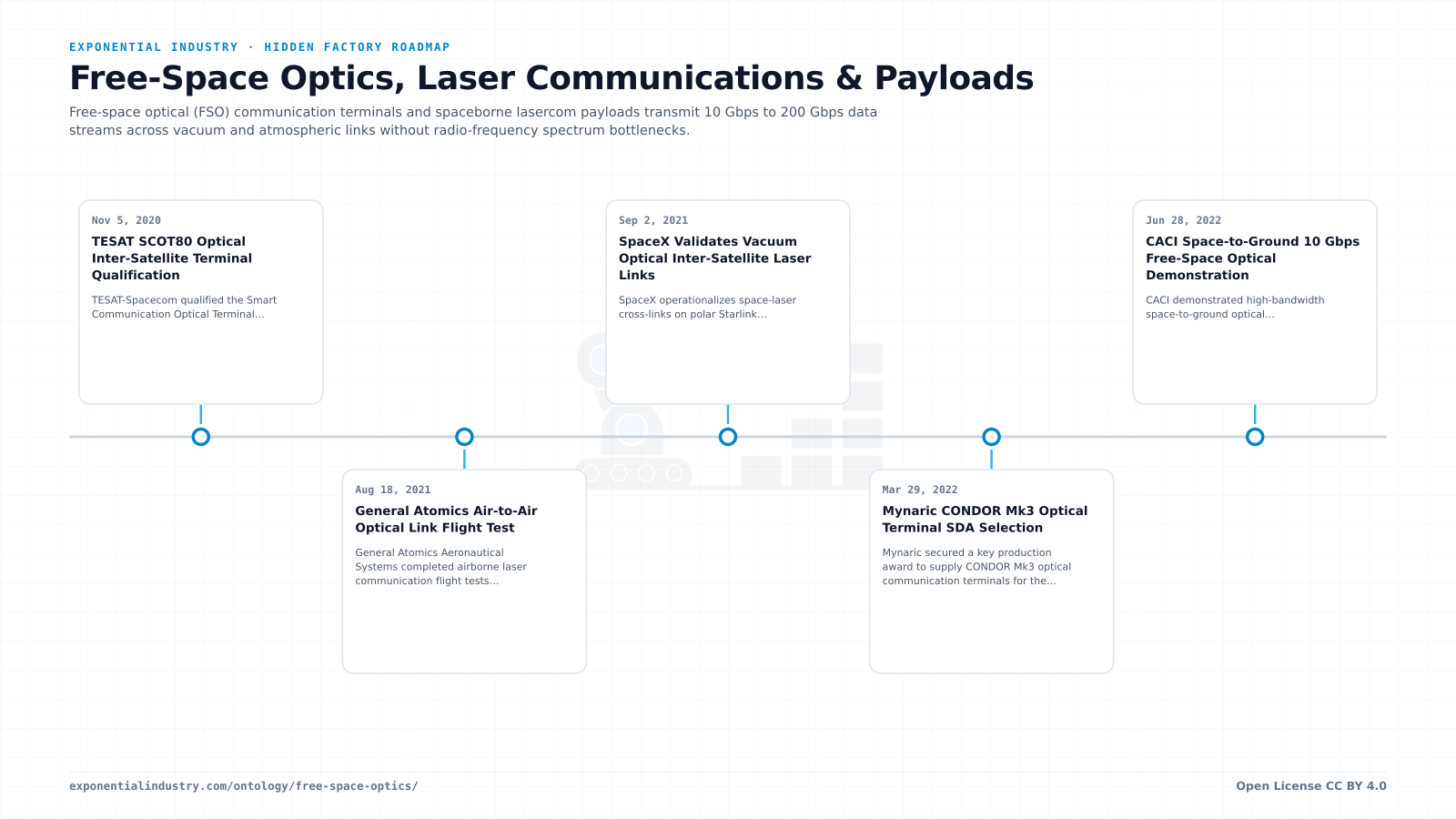
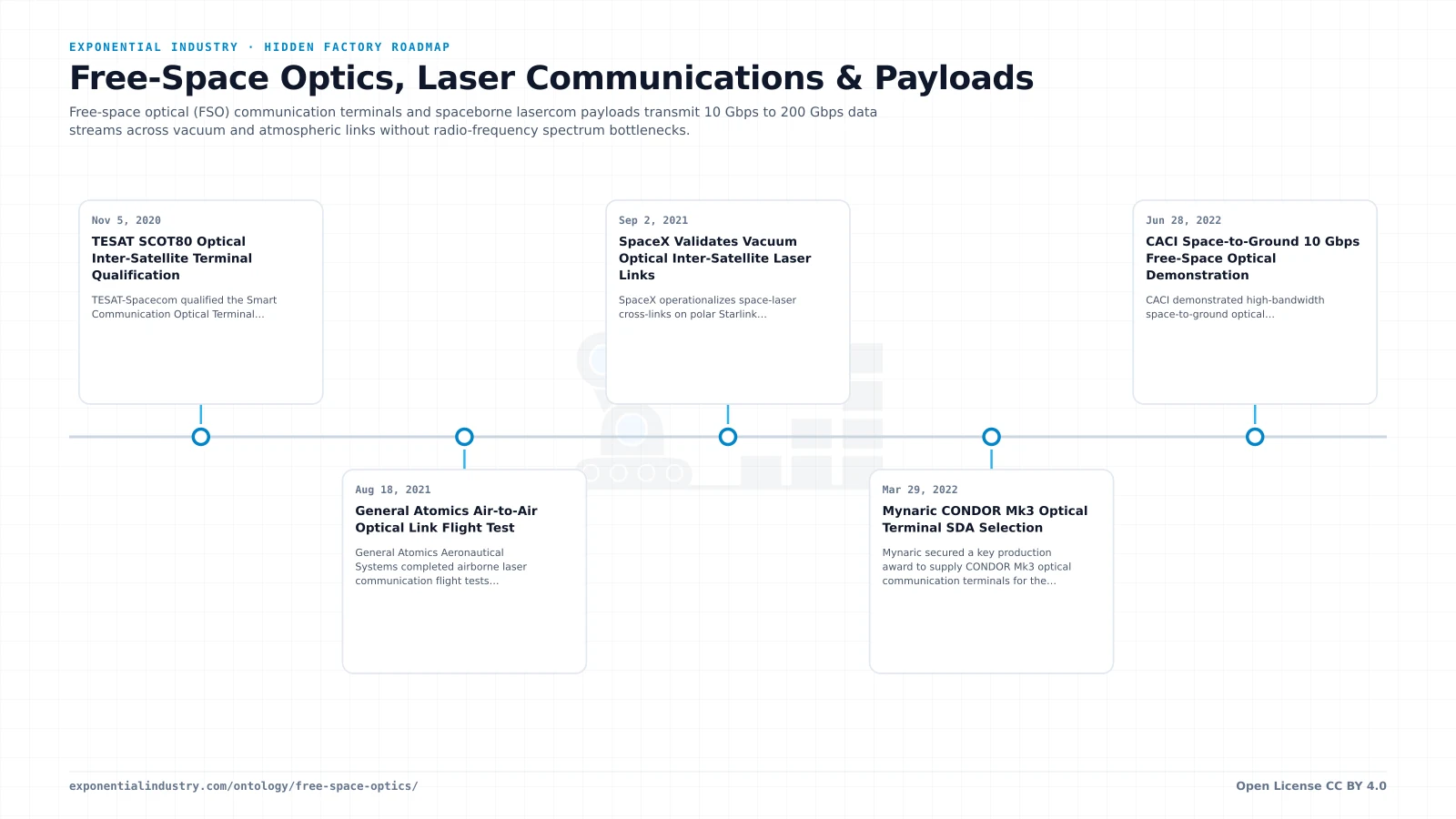
CACI Space-to-Ground 10 Gbps Free-Space Optical Demonstration
CACI demonstrated high-bandwidth space-to-ground optical communications links transmitting over 10 Gbps as part of NASA's Laser Communications Relay Demonstration /CACI Press Release/.
Mynaric CONDOR Mk3 Optical Terminal SDA Selection
Mynaric secured a key production award to supply CONDOR Mk3 optical communication terminals for the Space Development Agency Tranche 1 Transport Layer constellation /Business Wire/.
SpaceX Validates Vacuum Optical Inter-Satellite Laser Links
SpaceX operationalizes space-laser cross-links on polar Starlink satellites, transferring multi-gigabit data streams across vacuum at speed-of-light without ground hops. /[SpaceX Technical Briefing](https://twitter.com /SpaceX Technical Briefing/.
General Atomics Air-to-Air Optical Link Flight Test
General Atomics Aeronautical Systems completed airborne laser communication flight tests establishing 5 Gbps air-to-air optical links between Remotely Piloted Aircraft /General Atomics Press Release/.
TESAT SCOT80 Optical Inter-Satellite Terminal Qualification
TESAT-Spacecom qualified the Smart Communication Optical Terminal (SCOT80) delivering 1.8 Gbps optical links for inter-satellite crosslink constellations /TESAT Press Release/.
Core Architectures, Physical Parameters & Commercial Implementers
Our ontology tracks 3 primary architectures, hardware platforms, and material systems implementing Free-Space Optics, Laser Communications & Payloads.
Trunk & Competing Technology Branches
Incumbent Trunks vs. Challenger & Emerging PathwaysOptical Wireless Communication and Free-Space Optics
Wireless data transmission systems transmitting modulated infrared or visible light beams through air, space, or indoor environments to deliver multi-gigabit throughput free from RF spectrum congestion.
TRL Grounding: Broad technology area spanning line-of-sight lasercom, diffused optical indoor communications (Li-Fi/Wi-OW), and inter-satellite optical links.
Optical Inter-Satellite Laser Links (OISL)
| Architecture / System | Class & TRL | Technical Mechanism & Specifications | Commercial Implementers & OEMs |
|---|---|---|---|
| Optical Inter-Satellite Laser Links (OISL) | capability · TRL 8 First-of-a-Kind Qualified | Tracked hardware or software subsystem in the Exponential Industry knowledge graph. | SpaceX |
| Qunnect Room-Temperature Quantum Memory
Implements: Optical Wireless Communication and Free-Space Optics | product · TRL 8 First-of-a-Kind Qualified | Atomic quantum memory and entanglement source operating on existing telecom optical fibers without cryogenics. TRL 8 Grounding: Commercial product demonstrated in operational environments. | Qunnect |
| Light Links Wi-OW Optical Wireless Communication System
Implements: Optical Wireless Communication and Free-Space Optics | product · TRL 6 Pilot Line Validation | Non-line-of-sight optical wireless communication system using eye-safe diffused infrared laser light bounced off ambient surfaces to establish high-throughput, jam-proof, low-latency data links without radio frequency interference or regulatory licensing. TRL 6 Grounding: Functional prototypes engineered and validated in laboratory environments, backed by $6M pre-seed financing for commercial pilot deployments. | Light Links |
Related Deep-Dive Engineering Analyses
Primary technical teardowns, unit-economics models, and supply-chain bottleneck analyses related to Free-Space Optics, Laser Communications & Payloads.
Frequently Asked Questions
What is Free-Space Optics, Laser Communications & Payloads and what industrial engineering problems does it address?
Free-space optical (FSO) communication terminals and spaceborne lasercom payloads transmit 10 Gbps to 200 Gbps data streams across vacuum and atmospheric links without radio-frequency spectrum bottlenecks. Optical terminals pair 1,550-nanometer erbium-doped fiber amplifiers with fine-steering micro-electro-mechanical (MEMS) mirrors and sub-microradian acquisition, pointing, and tracking (APT) loops spanning 5,000 km orbital distances. SpaceX Starlink, CACI, Mynaric, Astrolight, and Light Links deploy optical inter-satellite links (OISL) and jam-resistant tactical laser transceivers.
What core technologies and manufacturing architectures comprise Free-Space Optics, Laser Communications & Payloads?
Key technical architectures and manufacturing innovations include:
- Optical Inter-Satellite Laser Links (OISL): SpaceX operationalizes space-laser cross-links on polar Starlink satellites, transferring multi-gigabit data streams across vacuum at speed-of-light without ground hops..
- General Atomics Air-to-Air Optical Link Flight Test: General Atomics Aeronautical Systems completed airborne laser communication flight tests establishing 5 Gbps air-to-air optical links between Remotely Piloted Aircraft.
- SpaceX Validates Vacuum Optical Inter-Satellite Laser Links: SpaceX operationalizes space-laser cross-links on polar Starlink satellites, transferring multi-gigabit data streams across vacuum at speed-of-light without ground hops..
- Mynaric CONDOR Mk3 Optical Terminal SDA Selection: Mynaric secured a key production award to supply CONDOR Mk3 optical communication terminals for the Space Development Agency Tranche 1 Transport Layer constellation.
- CACI Space-to-Ground 10 Gbps Free-Space Optical Demonstration: CACI demonstrated high-bandwidth space-to-ground optical communications links transmitting over 10 Gbps as part of NASA's Laser Communications Relay Demonstration.
Which companies and industrial facilities lead deployment in Free-Space Optics, Laser Communications & Payloads?
Leading industrial manufacturers, hyperscalers, and engineering operators include:
- SpaceX: SpaceX Validates Vacuum Optical Inter-Satellite Laser Links (Sep 2, 2021) — SpaceX operationalizes space-laser cross-links on polar Starlink satellites, transferring multi-gigabit data streams across vacuum at speed-of-light without ground hops..
What are key commercial projects and milestone achievements in Free-Space Optics, Laser Communications & Payloads?
Major industrial breakthroughs and commercial milestones include:
- TESAT SCOT80 Optical Inter-Satellite Terminal Qualification (Nov 5, 2020): TESAT completed flight qualification testing of compact laser communication terminals designed for mass manufacturing and multi-satellite constellation integration.
- General Atomics Air-to-Air Optical Link Flight Test (Aug 18, 2021): General Atomics demonstrated airborne optical communications terminals maintaining line-of-sight pointing and tracking during dynamic aircraft maneuvering.
- SpaceX Validates Vacuum Optical Inter-Satellite Laser Links (Sep 2, 2021): SpaceX operationalizes space-laser cross-links on polar Starlink satellites, transferring multi-gigabit data streams across vacuum at speed-of-light without ground hops..
- Mynaric CONDOR Mk3 Optical Terminal SDA Selection (Mar 29, 2022): Mynaric announced its selection to deliver laser communication terminals operating at multi-gigabit speeds for low-Earth orbit inter-satellite mesh networking.
- CACI Space-to-Ground 10 Gbps Free-Space Optical Demonstration (Jun 28, 2022): CACI demonstrated robust free-space optical data transmission from geosynchronous orbit to optical ground stations through atmospheric turbulence.
Related Technology Ontologies
Physical AI & Embodied Robotics
Artificial intelligence systems and autonomous machines that operate directly in and interact with the physical world, bridging bits to atoms. Spanning foundation models (Vision-Language-Action and World Foundation Models), physics-based simulation with synthetic data (Omniverse, Isaac Sim) to safely bridge Sim2Real, and embedded runtime computers (Jetson Thor, DRIVE AGX) executing closed-loop perception-action loops across humanoids, AMRs, adaptive manipulators, autonomous mobility, and smart spaces.
Data Center Power & Behind-the-Meter Generation
Behind-the-meter power generation and medium-voltage distribution architectures supply 100 MW to multi-gigawatt AI training campuses without waiting 5 to 8 years in utility transmission queues. Co-located energy parks pair aeroderivative natural gas turbines, solid-oxide fuel cells, or enhanced geothermal wells with 4-hour lithium iron phosphate (LFP) battery buffers to absorb millisecond GPU load steps. Inside the data hall, +/-400V and 800V DC busbars replace legacy 48V AC distribution to power 120 kW to 600 kW liquid-cooled racks from NVIDIA, Eaton, and Vertiv.
Rackscale AI Accelerators
Fully co-designed rack- and POD-scale AI systems that combine accelerators, host CPUs, scale-up fabric (NVLink-class domains), and scale-out networking in one thermal/mechanical package. Lineage runs from multi-GPU HGX/DGX boxes through Grace Hopper NVL32 domains to liquid-cooled 72-GPU racks (GB200, GB300, Vera Rubin) and competing racks such as AMD Helios. NVIDIA, AMD, and OEM rack builders (Dell, Supermicro) ship the current generation for AI-factory halls.