Dry Battery Electrode Manufacturing
- Exponential Industry
- 5 Milestones
Solvent-free battery electrode fabrication replacing toxic N-methyl-2-pyrrolidone (NMP) slurries and convective drying ovens with dry powder blending, shear fibrillation of polymer binders, and roll-to-roll calendering directly onto current collector foils. Eliminates 50- to 100-meter drying ovens, reduces processing energy by up to 40%, and enables thick electrode architectures with 97–98% active material loading. Equipment developers and commercial implementers include Tesla (Giga Texas), AM Batteries, LG Energy Solution, and Dragonfly Energy.
Readiness Assessment: Tesla has deployed dry cathode and dry anode on Model Y 4680 lines; AM Batteries and LGES operating pilot lines.
Active Dry Battery Electrode Manufacturing Engineering Roles
Explore verified engineering requisitions ($140,000 – $235,000+) with unredacted direct apply URLs and verified corporate alumni networks on Scholar.


AM Batteries and Coreshell $50M DOE Battery Manufacturing Award
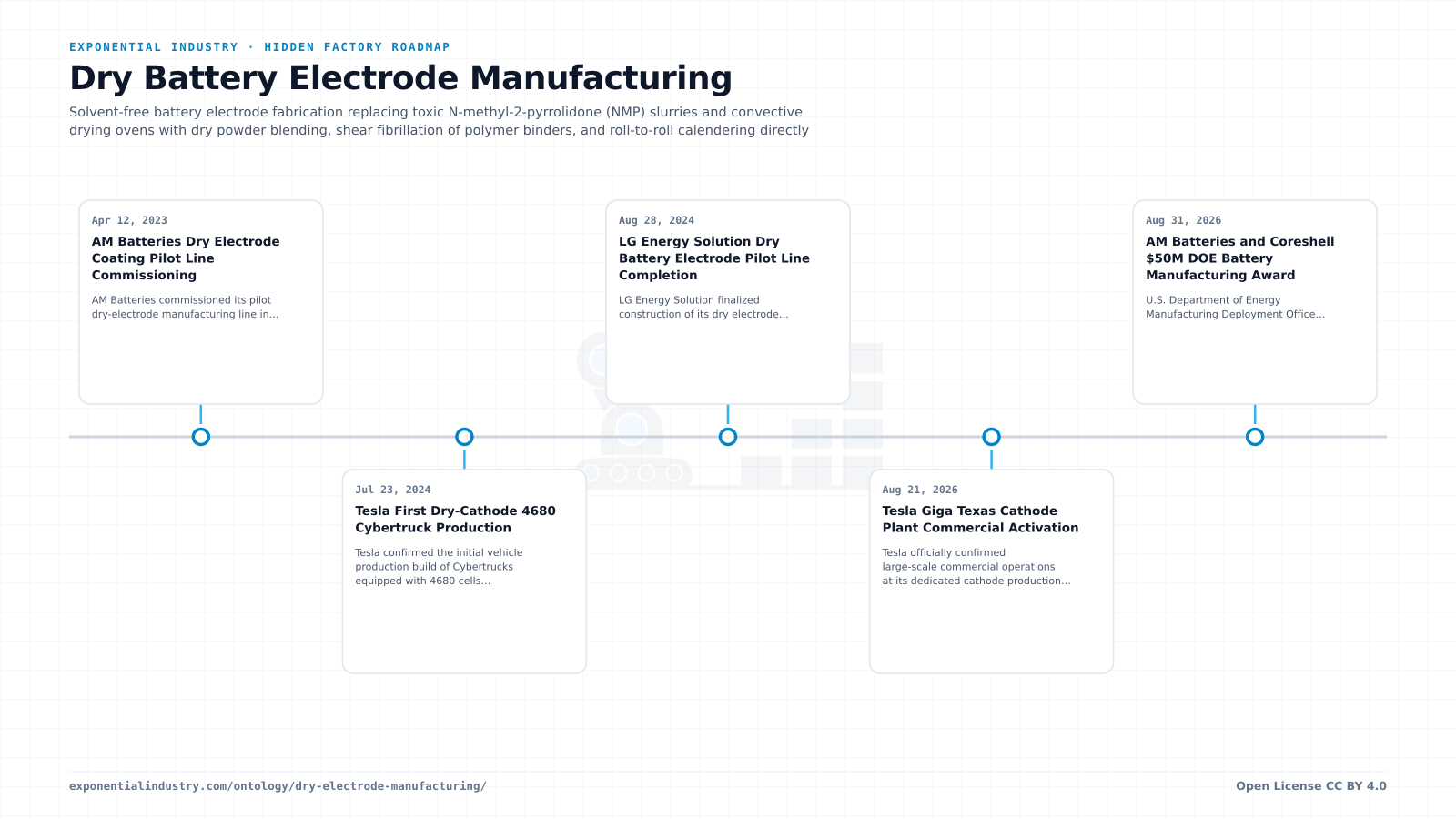
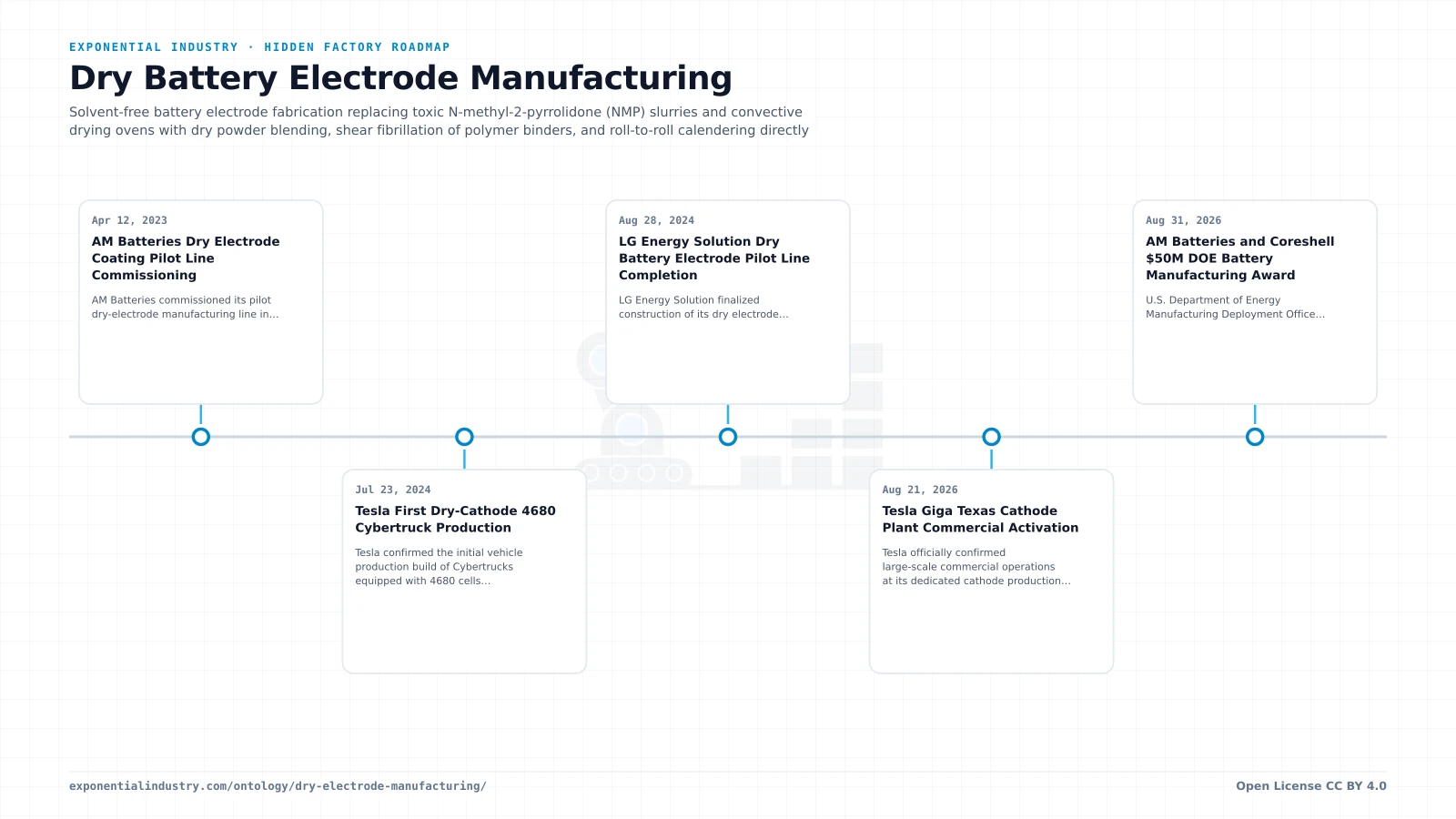
U.S. Department of Energy Manufacturing Deployment Office awarded $50M under the IIJA to a consortium led by Coreshell and AM Batteries to establish 2 GWh of electrode and 1.5 GWh of cell manufacturing capacity in the US using dry coating technology /PR Newswire/.
Tesla Giga Texas Cathode Plant Commercial Activation
Tesla officially confirmed large-scale commercial operations at its dedicated cathode production facility at Gigafactory Texas in Austin, supplying in-house dry cathode 4680 cell lines.
LG Energy Solution Dry Battery Electrode Pilot Line Completion
LG Energy Solution finalized construction of its dry electrode manufacturing pilot facility at the Ochang plant in South Korea to validate solvent-free electrode rolling /Korea Economic Daily/.
Tesla First Dry-Cathode 4680 Cybertruck Production
Tesla confirmed the initial vehicle production build of Cybertrucks equipped with 4680 cells manufactured using in-house dry-coated cathode electrodes /SEC / Tesla Shareholder Letter/.
AM Batteries Dry Electrode Coating Pilot Line Commissioning
AM Batteries commissioned its pilot dry-electrode manufacturing line in Acton, Massachusetts, eliminating toxic NMP solvent recovery from battery cathode fabrication /Business Wire/.
Core Architectures, Physical Parameters & Commercial Implementers
Our ontology tracks 4 primary architectures, hardware platforms, and material systems implementing Dry Battery Electrode Manufacturing.
Trunk & Competing Technology Branches
Incumbent Trunks vs. Challenger & Emerging PathwaysPTFE Binder Fibrillation & Multi-Roll Calendering (DBE)
Solvent-free electrode web formation using high-shear mixing to fibrillate polytetrafluoroethylene (PTFE) polymer binder into a self-supporting dry film calendered directly onto current collector foils.
TRL Grounding: Volume production on Tesla 4680 dry anode and cathode lines in Austin and Kato Road, eliminating NMP solvent drying ovens via high-shear PTFE fibrillation.
Electrostatic Dry Powder Spray & Hot-Roll Compaction
Dry electrode deposition architecture that electrostatically charges and sprays active-material/binder powder particles onto foil collectors followed by heated calender densification, avoiding high-shear PTFE degradation of cathode particles.
TRL Grounding: Pilot-line roll-to-roll electrode production demonstrated by AM Batteries and automotive OEM partners using PVDF/acrylic binders without PTFE fibrillation stress.
| Architecture / System | Class & TRL | Technical Mechanism & Specifications | Commercial Implementers & OEMs |
|---|---|---|---|
| Tesla 4680 Battery Cell | product · TRL 8 First-of-a-Kind Qualified | Tesla cylindrical 4680 cell format. Gigafactory Nevada page cites a 100 GWh 4680 cell factory expansion. TRL 8 Grounding: In production ramp; Gigafactory Nevada expanding 100 GWh 4680 capacity | Tesla |
| Tesla Dry Battery Electrode (DBE) System | process · TRL 8 First-of-a-Kind Qualified | Tesla's proprietary mechanical dry electrode process utilizing low-shear powder mixing, PTFE fibrillation, porous carbon microstructural scaffolding, and multi-pass calendering to manufacture thick, high-energy-density electrodes with only 1–2% binder loading. TRL 8 Grounding: Operating at production scale for both anode and cathode in 4680 cells at Giga Texas. | Tesla |
| AM Batteries Powder to Electrode Platform | platform · TRL 7 Field Prototype | Electrostatic dry spray and deposition coating platform that applies dry active materials, binders, and conductive additives directly onto current collectors without liquid carrier solvents or drying ovens, reducing CAPEX up to 40% and energy consumption by 40%. TRL 7 Grounding: Pilot line samples shipped to major cell maker; selected for 2 GWh DOE project. | AM Batteries Inc. |
| Neocarbonix | platform · TRL 7 Field Prototype | PFAS-free, PVDF-free, and NMP-free lithium-ion battery electrode architecture utilizing a 3D carbon nanotube conductive matrix. The process replaces toxic NMP solvent processing and fluoropolymer binders with water-based or dry mixing. The architecture reduces cathode processing footprint, eliminates hazardous solvent recovery, and increases cell energy density. TRL 7 Grounding: Pre-commercial pilot lines and OEM testing under joint development with GM Ventures and Samsung Ventures. | Nanoramic Laboratories |
Related Deep-Dive Engineering Analyses
Primary technical teardowns, unit-economics models, and supply-chain bottleneck analyses related to Dry Battery Electrode Manufacturing.
Frequently Asked Questions
What is Dry Battery Electrode Manufacturing and what industrial engineering problems does it address?
Solvent-free battery electrode fabrication replacing toxic N-methyl-2-pyrrolidone (NMP) slurries and convective drying ovens with dry powder blending, shear fibrillation of polymer binders, and roll-to-roll calendering directly onto current collector foils. Eliminates 50- to 100-meter drying ovens, reduces processing energy by up to 40%, and enables thick electrode architectures with 97–98% active material loading. Equipment developers and commercial implementers include Tesla (Giga Texas), AM Batteries, LG Energy Solution, and Dragonfly Energy.
What core technologies and manufacturing architectures comprise Dry Battery Electrode Manufacturing?
Key technical architectures and manufacturing innovations include:
- Tesla Dry Battery Electrode (DBE) System: Tesla's proprietary mechanical dry electrode process utilizing low-shear powder mixing, PTFE fibrillation, porous carbon microstructural scaffolding, and multi-pass calendering to manufacture thick, high-energy-density electrodes with only 1–2% binder loading.
- AM Batteries Powder to Electrode Platform: Electrostatic dry spray and deposition coating platform that applies dry active materials, binders, and conductive additives directly onto current collectors without liquid carrier solvents or drying ovens, reducing CAPEX up to 40% and energy consumption by 40%.
- Tesla 4680 Battery Cell: Tesla cylindrical 4680 cell format. Gigafactory Nevada page cites a 100 GWh 4680 cell factory expansion.
Which companies and industrial facilities lead deployment in Dry Battery Electrode Manufacturing?
Leading industrial manufacturers, hyperscalers, and engineering operators include:
- Tesla: Tesla First Dry-Cathode 4680 Cybertruck Production (Jul 23, 2024) — Tesla confirmed the start of Cybertruck test-fleet builds utilizing 4680 battery cells produced with in-house dry cathode process equipment at Giga Texas.
- AM Batteries Inc.: AM Batteries and Coreshell $50M DOE Battery Manufacturing Award (Aug 31, 2026) — AM Batteries announced today its role as a core subrecipient of a $50 million award from the U.S. Department of Energy's (DOE) Manufacturing Deployment Office (MDO) under the Infrastructure Investment and Jobs Act. The project, led by Coreshell Technologies, aims to build out approximately 2 gigawatt-hours of electrode manufacturing capacity and 1.5 gigawatt-hours of cell assembly capacity here in the United States.
What are key commercial projects and milestone achievements in Dry Battery Electrode Manufacturing?
Major industrial breakthroughs and commercial milestones include:
- AM Batteries Dry Electrode Coating Pilot Line Commissioning (Apr 12, 2023): AM Batteries announced commissioning of its electrostatic dry battery electrode spray coating line achieving high throughput without drying ovens.
- Tesla First Dry-Cathode 4680 Cybertruck Production (Jul 23, 2024): Tesla confirmed the start of Cybertruck test-fleet builds utilizing 4680 battery cells produced with in-house dry cathode process equipment at Giga Texas.
- LG Energy Solution Dry Battery Electrode Pilot Line Completion (Aug 28, 2024): LG Energy Solution completed pilot line setup for dry battery electrode manufacturing targeting 30% reduction in battery cell production costs by 2028.
- Tesla Giga Texas Cathode Plant Commercial Activation (Aug 21, 2026): Tesla officially confirmed large-scale commercial operations at its dedicated cathode production facility at Gigafactory Texas in Austin, supplying in-house dry cathode 4680 cell lines.
- AM Batteries and Coreshell $50M DOE Battery Manufacturing Award (Aug 31, 2026): AM Batteries announced today its role as a core subrecipient of a $50 million award from the U.S. Department of Energy's (DOE) Manufacturing Deployment Office (MDO) under the Infrastructure Investment and Jobs Act. The project, led by Coreshell Technologies, aims to build out approximately 2 gigawatt-hours of electrode manufacturing capacity and 1.5 gigawatt-hours of cell assembly capacity here in the United States.
Related Technology Ontologies
Physical AI & Embodied Robotics
Artificial intelligence systems and autonomous machines that operate directly in and interact with the physical world, bridging bits to atoms. Spanning foundation models (Vision-Language-Action and World Foundation Models), physics-based simulation with synthetic data (Omniverse, Isaac Sim) to safely bridge Sim2Real, and embedded runtime computers (Jetson Thor, DRIVE AGX) executing closed-loop perception-action loops across humanoids, AMRs, adaptive manipulators, autonomous mobility, and smart spaces.
Data Center Power & Behind-the-Meter Generation
Behind-the-meter power generation and medium-voltage distribution architectures supply 100 MW to multi-gigawatt AI training campuses without waiting 5 to 8 years in utility transmission queues. Co-located energy parks pair aeroderivative natural gas turbines, solid-oxide fuel cells, or enhanced geothermal wells with 4-hour lithium iron phosphate (LFP) battery buffers to absorb millisecond GPU load steps. Inside the data hall, +/-400V and 800V DC busbars replace legacy 48V AC distribution to power 120 kW to 600 kW liquid-cooled racks from NVIDIA, Eaton, and Vertiv.
Rackscale AI Accelerators
Fully co-designed rack- and POD-scale AI systems that combine accelerators, host CPUs, scale-up fabric (NVLink-class domains), and scale-out networking in one thermal/mechanical package. Lineage runs from multi-GPU HGX/DGX boxes through Grace Hopper NVL32 domains to liquid-cooled 72-GPU racks (GB200, GB300, Vera Rubin) and competing racks such as AMD Helios. NVIDIA, AMD, and OEM rack builders (Dell, Supermicro) ship the current generation for AI-factory halls.