Avionics, Flight Hardware & Real-Time GNC
- Exponential Industry
- 5 Milestones
Flight computing, guidance, navigation, and control (GNC) hardware and deterministic real-time software govern orbital launch vehicles, satellites, and autonomous aircraft. Architectures combine radiation-tolerant system-on-chips, fault-tolerant triple-modular-redundant (TMR) flight computers, fiber-optic gyroscopes, and convex-optimization landing algorithms executing at 100 Hz to 1,000 Hz control rates. SpaceX, Honeywell Aerospace, L3Harris, Shield AI, and Anduril engineer flight-critical avionics for reusable rocket boosters, GPS-denied drones, and defense interceptors.
Active Avionics, Flight Hardware & Real-Time GNC Engineering Roles
Explore verified engineering requisitions ($105,000 – $220,000+) with unredacted direct apply URLs and verified corporate alumni networks on Scholar.

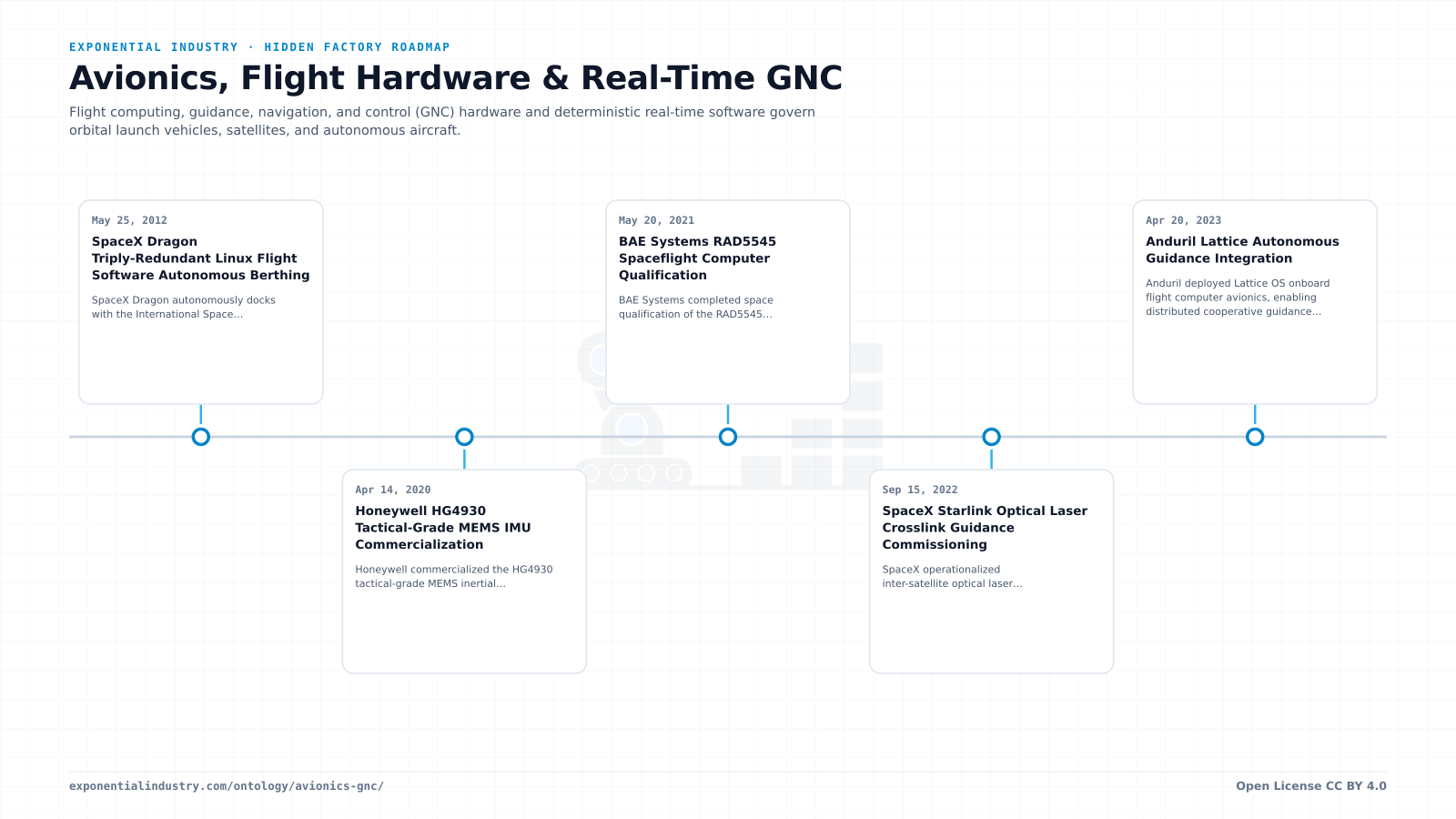
Anduril Lattice Autonomous Guidance Integration
Anduril deployed Lattice OS onboard flight computer avionics, enabling distributed cooperative guidance and waypoint recalculation without satellite signal reliance /Anduril Industries/.
SpaceX Starlink Optical Laser Crosslink Guidance Commissioning
SpaceX operationalized inter-satellite optical laser crosslinks across its v1.5 constellation, enabling autonomous orbital route recalculation and precision constellation station-keeping /FCC Regulatory Filing/.
BAE Systems RAD5545 Spaceflight Computer Qualification
BAE Systems completed space qualification of the RAD5545 quad-core radiation-hardened flight processor, delivering 5.6 GFLOPS for orbital guidance and autonomous navigation /BAE Systems Press Release/.
Honeywell HG4930 Tactical-Grade MEMS IMU Commercialization
Honeywell commercialized the HG4930 tactical-grade MEMS inertial measurement unit, delivering low-drift guidance for autonomous aerial and marine systems in GPS-denied environments /Honeywell Aerospace/.
SpaceX Dragon Triply-Redundant Linux Flight Software Autonomous Berthing
SpaceX Dragon autonomously docks with the International Space Station, validated by NASA using triply-redundant COTS processors running hard real-time Linux flight algorithms. /[NASA Commercial Crew Program](https://www.nasa.gov /NASA Commercial Crew Program/.
Core Architectures, Physical Parameters & Commercial Implementers
Our ontology tracks 2 primary architectures, hardware platforms, and material systems implementing Avionics, Flight Hardware & Real-Time GNC.
Trunk & Competing Technology Branches
Incumbent Trunks vs. Challenger & Emerging PathwaysFault-Tolerant Triply-Redundant Flight Computers
Flight-proven across commercial orbital rockets and human spaceflight programs.
Vaeridion Microliner Electric Regional Aircraft
Nine-passenger battery-electric regional aircraft with structural wing-integrated battery packs engineered for European regional routes.
TRL Grounding: Detailed aircraft design, wind tunnel aerodynamic testing, and preliminary battery integration for regional certification.
| Architecture / System | Class & TRL | Technical Mechanism & Specifications | Commercial Implementers & OEMs |
|---|---|---|---|
| Fault-Tolerant Triply-Redundant Flight Computers | platform · TRL 9 Commercial Scale | Flight-proven across commercial orbital rockets and human spaceflight programs. | Multiple OEMs |
| Vaeridion Microliner Electric Regional Aircraft | product · TRL 6 Pilot Line Validation | Nine-passenger battery-electric regional aircraft with structural wing-integrated battery packs engineered for European regional routes. TRL 6 Grounding: Detailed aircraft design, wind tunnel aerodynamic testing, and preliminary battery integration for regional certification. | Vaeridion |
Frequently Asked Questions
What is Avionics, Flight Hardware & Real-Time GNC and what industrial engineering problems does it address?
Flight computing, guidance, navigation, and control (GNC) hardware and deterministic real-time software govern orbital launch vehicles, satellites, and autonomous aircraft. Architectures combine radiation-tolerant system-on-chips, fault-tolerant triple-modular-redundant (TMR) flight computers, fiber-optic gyroscopes, and convex-optimization landing algorithms executing at 100 Hz to 1,000 Hz control rates. SpaceX, Honeywell Aerospace, L3Harris, Shield AI, and Anduril engineer flight-critical avionics for reusable rocket boosters, GPS-denied drones, and defense interceptors.
What core technologies and manufacturing architectures comprise Avionics, Flight Hardware & Real-Time GNC?
Key technical architectures and manufacturing innovations include:
- Fault-Tolerant Triply-Redundant Flight Computers: SpaceX Dragon autonomously docks with the International Space Station, validated by NASA using triply-redundant COTS processors running hard real-time Linux flight algorithms..
- SpaceX Dragon Triply-Redundant Linux Flight Software Autonomous Berthing: SpaceX Dragon autonomously docks with the International Space Station, validated by NASA using triply-redundant COTS processors running hard real-time Linux flight algorithms..
- Honeywell HG4930 Tactical-Grade MEMS IMU Commercialization: Honeywell commercialized the HG4930 tactical-grade MEMS inertial measurement unit, delivering low-drift guidance for autonomous aerial and marine systems in GPS-denied environments.
- SpaceX Starlink Optical Laser Crosslink Guidance Commissioning: SpaceX operationalized inter-satellite optical laser crosslinks across its v1.5 constellation, enabling autonomous orbital route recalculation and precision constellation station-keeping.
- Anduril Lattice Autonomous Guidance Integration: Anduril deployed Lattice OS onboard flight computer avionics, enabling distributed cooperative guidance and waypoint recalculation without satellite signal reliance.
Which companies and industrial facilities lead deployment in Avionics, Flight Hardware & Real-Time GNC?
Leading industrial manufacturers, hyperscalers, and engineering operators include:
- SpaceX: SpaceX Dragon Triply-Redundant Linux Flight Software Autonomous Berthing (May 25, 2012) — SpaceX Dragon autonomously docks with the International Space Station, validated by NASA using triply-redundant COTS processors running hard real-time Linux flight algorithms..
What are key commercial projects and milestone achievements in Avionics, Flight Hardware & Real-Time GNC?
Major industrial breakthroughs and commercial milestones include:
- SpaceX Dragon Triply-Redundant Linux Flight Software Autonomous Berthing (May 25, 2012): SpaceX Dragon autonomously docks with the International Space Station, validated by NASA using triply-redundant COTS processors running hard real-time Linux flight algorithms..
- Honeywell HG4930 Tactical-Grade MEMS IMU Commercialization (Apr 14, 2020): Honeywell introduced upgraded HG4930 inertial measurement units combining miniature solid-state MEMS gyroscopes and accelerometers for aerospace navigation.
- BAE Systems RAD5545 Spaceflight Computer Qualification (May 20, 2021): BAE Systems qualified its next-generation radiation-hardened multi-core processor designed to execute high-throughput autonomous spacecraft navigation algorithms.
- SpaceX Starlink Optical Laser Crosslink Guidance Commissioning (Sep 15, 2022): SpaceX confirmed active space-to-space optical communications links interconnecting satellites across orbital planes to reduce ground relay dependency.
- Anduril Lattice Autonomous Guidance Integration (Apr 20, 2023): Anduril demonstrated multi-agent collaborative guidance capabilities running directly on edge avionics hardware across uncrewed aerial platforms.
Related Technology Ontologies
Physical AI & Embodied Robotics
Artificial intelligence systems and autonomous machines that operate directly in and interact with the physical world, bridging bits to atoms. Spanning foundation models (Vision-Language-Action and World Foundation Models), physics-based simulation with synthetic data (Omniverse, Isaac Sim) to safely bridge Sim2Real, and embedded runtime computers (Jetson Thor, DRIVE AGX) executing closed-loop perception-action loops across humanoids, AMRs, adaptive manipulators, autonomous mobility, and smart spaces.
Data Center Power & Behind-the-Meter Generation
Behind-the-meter power generation and medium-voltage distribution architectures supply 100 MW to multi-gigawatt AI training campuses without waiting 5 to 8 years in utility transmission queues. Co-located energy parks pair aeroderivative natural gas turbines, solid-oxide fuel cells, or enhanced geothermal wells with 4-hour lithium iron phosphate (LFP) battery buffers to absorb millisecond GPU load steps. Inside the data hall, +/-400V and 800V DC busbars replace legacy 48V AC distribution to power 120 kW to 600 kW liquid-cooled racks from NVIDIA, Eaton, and Vertiv.
Rackscale AI Accelerators
Fully co-designed rack- and POD-scale AI systems that combine accelerators, host CPUs, scale-up fabric (NVLink-class domains), and scale-out networking in one thermal/mechanical package. Lineage runs from multi-GPU HGX/DGX boxes through Grace Hopper NVL32 domains to liquid-cooled 72-GPU racks (GB200, GB300, Vera Rubin) and competing racks such as AMD Helios. NVIDIA, AMD, and OEM rack builders (Dell, Supermicro) ship the current generation for AI-factory halls.