Autonomous Mobility & Driverless Vehicle Systems
- Exponential Industry
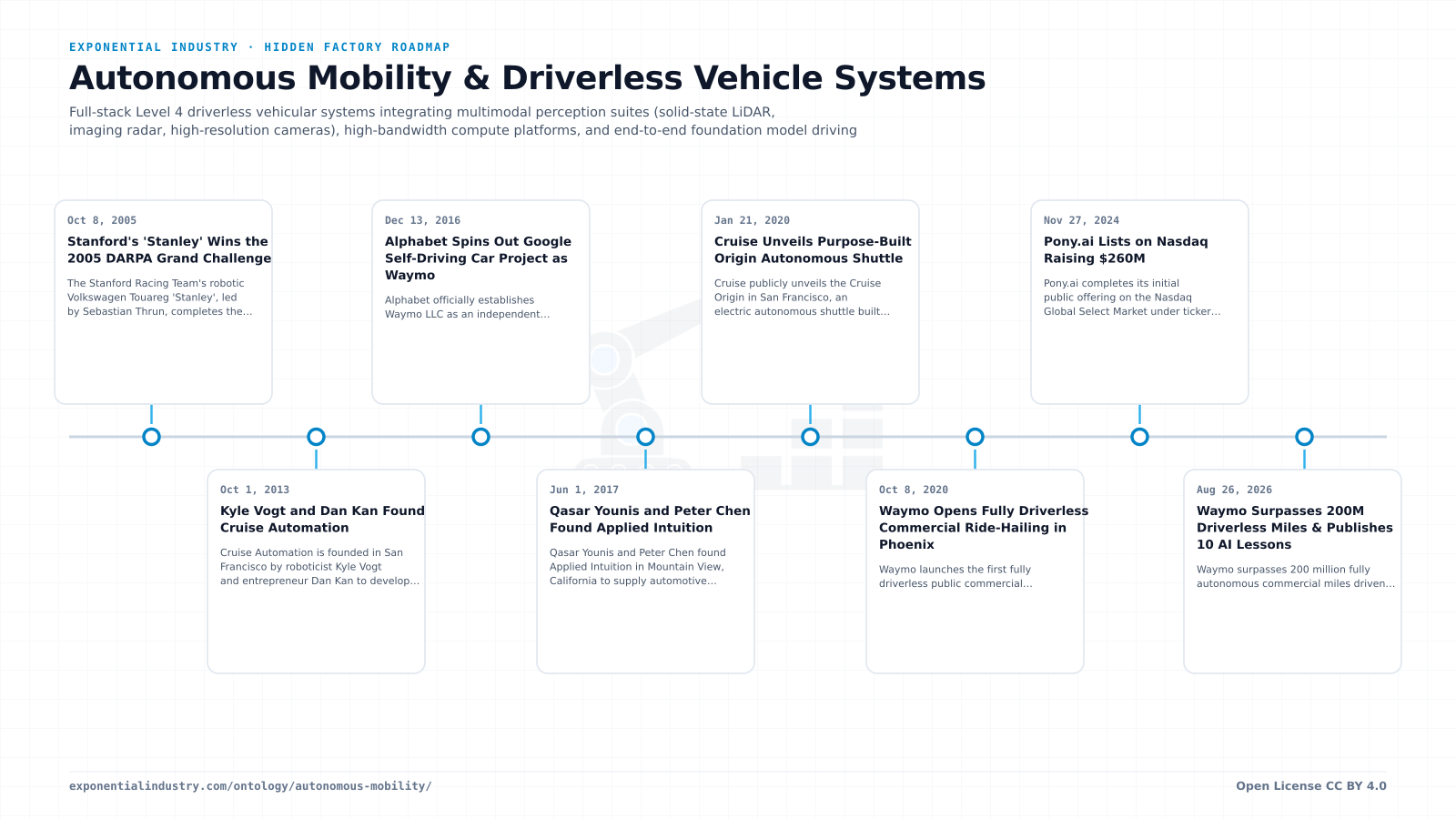
- 17 Milestones
Full-stack Level 4 driverless vehicular systems integrating multimodal perception suites (solid-state LiDAR, imaging radar, high-resolution cameras), high-bandwidth compute platforms, and end-to-end foundation model driving policies. Tracing from the 2005 DARPA Grand Challenge won by Stanford's robotic Stanley Touareg, commercial architectures operate fully driverless fleets across millions of public road miles. Key commercial operators and software platforms include Alphabet's Waymo Driver, Pony.ai, Tesla Cybercab, comma.ai openpilot, and Applied Intuition simulation infrastructure.
Readiness Assessment: Area: commercial Level 4 driverless vehicle fleets operate without safety drivers across multiple metropolitan markets (Waymo, Pony.ai), while edge-case handling, adverse weather validation, and cross-jurisdictional scaling continue advancing towards ubiquity.
Active Autonomous Mobility & Driverless Vehicle Systems Engineering Roles
Explore verified engineering requisitions ($145,000 – $260,000+) with unredacted direct apply URLs and verified corporate alumni networks on Scholar.
Waymo Surpasses 200M Driverless Miles & Publishes 10 AI Lessons
Waymo surpasses 200 million fully autonomous commercial miles driven and publishes '10 AI Lessons from Driving 200+ Million Fully Autonomous Miles' by Srikanth Thirumalai, articulating foundational principles of sensor redundancy, foundation models, and the reality gap between supervised L2 assist and driverless L4 operations /Waymo/.
General Motors Abandons Dedicated Cruise Origin Robotaxi
General Motors announces it is canceling development of the dedicated Cruise Origin robotaxi and restructuring the division to cut more than $1 billion in annual autonomous vehicle spending, absorbing Cruise teams into GM to focus on Super Cruise personal vehicle driver assistance /Car and Driver/.
Pony.ai Lists on Nasdaq Raising $260M
Pony.ai completes its initial public offering on the Nasdaq Global Select Market under ticker PONY, raising $260 million to scale its commercial autonomous robotaxi and freight trucking operations /Waymo/.
California DMV Suspends Cruise Autonomous Deployment Permits
The California Department of Motor Vehicles suspends Cruise's autonomous vehicle deployment and testing permits in San Francisco following an October 2 accident involving a pedestrian, precipitating a nationwide fleet grounding and the resignation of CEO Kyle Vogt /Car and Driver/.
Ford and Volkswagen Shut Down Argo AI
Ford and Volkswagen abruptly shut down and liquidate Argo AI after investing more than $3.6 billion, with Ford recording a $2.7 billion non-cash impairment charge and both automakers pivoting capital toward near-term Level 2+ and Level 3 driver-assistance systems /CNBC/.
Waymo Opens Fully Driverless Commercial Ride-Hailing in Phoenix
Waymo launches the first fully driverless public commercial ride-hailing service in the Phoenix East Valley, removing human safety operators from vehicle cabins for paying members of the public /Waymo/.
Cruise Unveils Purpose-Built Origin Autonomous Shuttle
Cruise publicly unveils the Cruise Origin in San Francisco, an electric autonomous shuttle built without steering wheels, pedals, or driver controls designed specifically for commercial urban ride-pooling /Car and Driver/.
Qasar Younis and Peter Chen Found Applied Intuition
Qasar Younis and Peter Chen found Applied Intuition in Mountain View, California to supply automotive simulation and safety validation infrastructure for autonomous driving programs /IEEE Spectrum/.
James Peng and Lou Tiancheng Found Pony.ai
Former Google and Baidu autonomous driving architects James Peng and Lou Tiancheng found Pony.ai to engineer Level 4 autonomous mobility solutions in the United States and China /Waymo/.
Founding of Argo AI and Ford's $1B Commitment
Bryan Salesky and Peter Rander found Argo AI in Pittsburgh; Ford Motor Company announces a landmark $1 billion multi-year investment to develop commercial Level 4 autonomous vehicle fleets /CNBC/.
Alphabet Spins Out Google Self-Driving Car Project as Waymo
Alphabet officially establishes Waymo LLC as an independent subsidiary, transitioning Google's seven-year autonomous vehicle R&D project into a commercial autonomous ride-hailing business /Waymo/.
comma.ai Open-Sources openpilot
comma.ai open-sources openpilot on GitHub as an alternative to proprietary ADAS, releasing drive-by-wire robotics code and neural network vision models to the public /IEEE Spectrum/.
George Hotz Founds comma.ai
George Hotz founds comma.ai in San Francisco to create affordable, open-source autonomous driving software using end-to-end machine learning /IEEE Spectrum/.
Kyle Vogt and Dan Kan Found Cruise Automation
Cruise Automation is founded in San Francisco by roboticist Kyle Vogt and entrepreneur Dan Kan to develop autonomous vehicle technology /Car and Driver/.
Google Inception of Project Chauffeur
Google initiates its Self-Driving Car Project (Project Chauffeur) under Google X led by Sebastian Thrun, developing autonomous vehicle technology that subsequently matures into Waymo /Waymo/.
Stanford's 'Stanley' Wins the 2005 DARPA Grand Challenge
The Stanford Racing Team's robotic Volkswagen Touareg 'Stanley', led by Sebastian Thrun, completes the 132-mile Mojave Desert course in 6 hours 53 minutes to win the $2 million DARPA Grand Challenge, demonstrating the viability of probabilistic machine learning and sensor fusion in autonomous driving /IEEE Spectrum/ /Stanford University School of Engineering/ /Stanford University/.
Inaugural DARPA Grand Challenge in the Mojave Desert
The Defense Advanced Research Projects Agency holds the inaugural DARPA Grand Challenge across 142 miles of Mojave Desert terrain; none of the 15 competing autonomous vehicles finishes the course, establishing a historic benchmark for robotic vehicle research /IEEE Spectrum/.
Core Architectures, Physical Parameters & Commercial Implementers
Our ontology tracks 14 primary architectures, hardware platforms, and material systems implementing Autonomous Mobility & Driverless Vehicle Systems.
Trunk & Competing Technology Branches
Incumbent Trunks vs. Challenger & Emerging PathwaysLevel 4 Autonomous Driving Systems (ADS)
Full-stack Level 4 autonomous vehicle software architectures integrating multi-modal perception (LiDAR, radar, cameras), continuous localization, occupancy grids, behavioral planning, and real-time motion control without a human driver in designated operational design domains (ODDs).
TRL Grounding: Commercial driverless robotaxi deployments operating millions of driverless miles (Waymo One, Cruise, Pony.ai).
Level 2+ / Level 3 Vision-Centric Highway Driver Assist
Consumer automotive driver-assist systems providing automated lane centering, adaptive cruise control, and hands-free highway driving with driver monitoring cameras and camera-vision neural networks.
TRL Grounding: Mass-production automotive highway autopilot and hands-free driving stacks (Ford BlueCruise, comma openpilot, Tesla Autopilot).
Purpose-Built Driverless Shuttle Architecture
Vehicle mechanical and electrical chassis architectures designed without steering wheels, pedals, or manual driver controls, incorporating symmetrical bidirectional propulsion, quadri-steer maneuvering, and integrated sensor pods.
TRL Grounding: Purpose-built driverless vehicles with bidirectional drive and no manual controls (Cruise Origin, Zoox Robotaxi).
| Architecture / System | Class & TRL | Technical Mechanism & Specifications | Commercial Implementers & OEMs |
|---|---|---|---|
| Waymo Driver
Implements: Level 4 Autonomous Driving Systems (ADS) | product · TRL 9 Commercial Scale | Commercial Level 4 autonomous driving system engineered by Waymo. Combines custom-designed 360-degree LiDAR, perimeter imaging radar, long-range high-dynamic-range cameras, onboard foundation models, and high-definition spatial map priors to operate commercial driverless ride-hailing services across 200+ million autonomous miles. TRL 9 Grounding: Actual system proven in operational environment through hundreds of millions of commercial driverless rider-only miles across major metropolitan areas including Phoenix, San Francisco, and Los Angeles. | Waymo |
| Cruise Origin
Implements: Purpose-Built Driverless Shuttle Architecture | product · TRL 7 Halted / Restructured | Purpose-built, steering-wheel-free electric autonomous shuttle designed by Cruise and General Motors with opposing passenger seats and sliding doors for dedicated urban ride-hailing fleets. Development was canceled by General Motors in December 2024 to cut costs and refocus engineering on passenger ADAS. TRL 7 Grounding: Demonstrated functional pre-production prototypes on closed-course and public-road testing environments before GM canceled program development in December 2024. | Cruise, General Motors |
| Pony.ai Virtual Driver | product · TRL 8 First-of-a-Kind Qualified | Full-stack Level 4 autonomous driving software and hardware platform developed by Pony.ai. Operates across passenger robotaxis (PonyPilot+) and commercial heavy-duty trucks (Robotruck), featuring multi-sensor fusion, HD mapping, and redundant drive-by-wire vehicle interfaces deployed in China and the US. TRL 8 Grounding: Actual system completed and qualified through test and demonstration with commercial robotaxi and robotruck fleet deployments operating under regulatory permits in China and the United States. | Pony.ai |
| Argo AI Autonomous Driving System (SDS) | product · TRL 7 Halted / Restructured | Level 4 self-driving system developed by Argo AI for Ford and Volkswagen commercial fleets. Featured custom Geiger-mode LiDAR, camera-radar fusion, and cloud-based fleet dispatch software; commercial development was dissolved in October 2022 when backing OEMs withdrew funding. TRL 7 Grounding: Demonstrated full operational prototype in commercial pilot testing with Ford and VW across Pittsburgh, Miami, and Austin before project dissolution in 2022. | Argo AI |
| Applied Intuition Simulation & Validation Suite | product · TRL 9 Commercial Scale | End-to-end synthetic simulation, sensor modeling, scenario generation, and regulatory compliance platform for autonomous vehicle and ADAS development. Enables automotive OEMs and autonomous mobility operators to validate safety cases across millions of virtual edge cases prior to public road deployment. TRL 9 Grounding: Actual system proven in operational environment across top global automotive OEMs, Tier 1 suppliers, and AV operators for safety verification and homologation. | Applied Intuition |
| comma openpilot | product · TRL 8 First-of-a-Kind Qualified | Open-source Level 2+ driver assistance and autonomous driving software agent created by comma.ai. Utilizes end-to-end deep learning trained on hundreds of millions of user-driven road miles, communicating via vehicle CAN buses to provide adaptive cruise control, automated lane centering, and driver monitoring on consumer vehicles. TRL 8 Grounding: Actual system deployed to thousands of consumer vehicles worldwide logging over 100 million real-world driving miles with active community validation. | comma.ai |
| Stanley Autonomous Vehicle | product · TRL 7 Field Prototype | Robotic 2004 Volkswagen Touareg R5 TDI engineered by the Stanford Racing Team to win the 2005 DARPA Grand Challenge. Integrated five roof-mounted SICK LiDARs, a single-chip color camera, Doppler radar, GPS/IMU navigation, and probabilistic machine learning algorithms for real-time terrain mapping and speed control without human intervention. TRL 7 Grounding: Successfully demonstrated full system prototype operating in operational environment by traversing 132 miles of rugged desert terrain to win the 2005 DARPA Grand Challenge. | Stanford Racing Team |
| Kodiak Driver Autonomous Trucking System | product · TRL 8 First-of-a-Kind Qualified | Autonomous vehicle driving hardware and software platform engineered specifically for Class 8 freight trucks and commercial logistics. TRL 8 Grounding: Commercial deployment and Driver-as-a-Service customer fleet integration on Class 8 long-haul routes. | Kodiak Robotics Deployed with: DTL Transport |
| BMW Mobile Data Recorder (MDR) | platform · TRL 9 Commercial Scale | In-vehicle telemetry acquisition system capturing over 10,000 sensor and ECU signals (5–10 TB/week per vehicle) during road validation and durability testing. TRL 9 Grounding: Standard vehicle data logger system capturing telemetry across all BMW R&D development fleets. | BMW Group |
| Composite Interlaminar Stress Elasticity Formulation | process · TRL 9 Commercial Scale | Analytical elasticity method for resolving boundary layer shear and normal stresses causing free-edge delamination in composite plies. TRL 9 Grounding: Standard methodology embedded into commercial finite element analysis software for aerospace composites. | Air Force Materials Laboratory (AFML / AFRL) |
| Ford BlueCruise
Implements: Level 2+ / Level 3 Vision-Centric Highway Driver Assist | product · TRL 8 First-of-a-Kind Qualified | Hands-off, eyes-on highway driver-assist (Blue Zones). Official Fathom page: every truck ships BlueCruise-capable hardware; next-gen integration with Apple Maps. TRL 8 Grounding: Commercial product: Ford BlueCruise. | Ford Motor Company |
| Bulwark Caravel USV | platform · TRL 7 Field Prototype | Series of autonomous landing craft (15-ft, 35-ft, and 55-ft variants) engineered for contested logistics in GPS-denied littoral waters. The vessels execute beaching, automated payload discharge, and extraction without crew intervention. Manufacturing is supported through partnership with Japan's Onomichi Dockyard. TRL 7 Grounding: Quarter-scale and 35-foot uncrewed landing craft demonstrators operating in littoral sea trials. | Bulwark Dynamics |
| Automotive Cold-Gas Reaction Control System | product · TRL 6 Pilot Line Validation | Compressed gas reaction control system adapting aerospace cold-gas attitude thruster architectures and composite overwrapped pressure vessels (COPVs) at 10,000 PSI to provide active acceleration, deceleration, and downforce control for passenger supercars. TRL 6 Grounding: Integrated on production-intent prototypes and demonstrated at test tracks; awaiting volume production qualification. | Tesla |
| Poseidon Egret Cargo Aircraft | product · TRL 6 Pilot Line Validation | Unmanned regional cargo aircraft featuring a 50-foot wingspan and a 4,000-pound payload capacity powered by an efficient internal combustion engine. Optimized for short-field takeoffs and landings from unpaved and austere airfields without ground handling equipment. Tailored for commercial feeder logistics and high-risk contested defense supply missions. TRL 6 Grounding: Quarter-scale demonstrator flight completed; full-scale prototype scheduled for 2026 flight trials. | Poseidon Aerospace |
Frequently Asked Questions
What is Autonomous Mobility & Driverless Vehicle Systems and what industrial engineering problems does it address?
Full-stack Level 4 driverless vehicular systems integrating multimodal perception suites (solid-state LiDAR, imaging radar, high-resolution cameras), high-bandwidth compute platforms, and end-to-end foundation model driving policies. Tracing from the 2005 DARPA Grand Challenge won by Stanford's robotic Stanley Touareg, commercial architectures operate fully driverless fleets across millions of public road miles. Key commercial operators and software platforms include Alphabet's Waymo Driver, Pony.ai, Tesla Cybercab, comma.ai openpilot, and Applied Intuition simulation infrastructure.
What core technologies and manufacturing architectures comprise Autonomous Mobility & Driverless Vehicle Systems?
Key technical architectures and manufacturing innovations include:
- Waymo Driver: Commercial Level 4 autonomous driving system engineered by Waymo. Combines custom-designed 360-degree LiDAR, perimeter imaging radar, long-range high-dynamic-range cameras, onboard foundation models, and high-definition spatial map priors to operate commercial driverless ride-hailing services across 200+ million autonomous miles.
- Pony.ai Virtual Driver: Full-stack Level 4 autonomous driving software and hardware platform developed by Pony.ai. Operates across passenger robotaxis (PonyPilot+) and commercial heavy-duty trucks (Robotruck), featuring multi-sensor fusion, HD mapping, and redundant drive-by-wire vehicle interfaces deployed in China and the US.
- Applied Intuition Simulation & Validation Suite: End-to-end synthetic simulation, sensor modeling, scenario generation, and regulatory compliance platform for autonomous vehicle and ADAS development. Enables automotive OEMs and autonomous mobility operators to validate safety cases across millions of virtual edge cases prior to public road deployment.
- Cruise Origin: Purpose-built, steering-wheel-free electric autonomous shuttle designed by Cruise and General Motors with opposing passenger seats and sliding doors for dedicated urban ride-hailing fleets. Development was canceled by General Motors in December 2024 to cut costs and refocus engineering on passenger ADAS.
- Argo AI Autonomous Driving System (SDS): Level 4 self-driving system developed by Argo AI for Ford and Volkswagen commercial fleets. Featured custom Geiger-mode LiDAR, camera-radar fusion, and cloud-based fleet dispatch software; commercial development was dissolved in October 2022 when backing OEMs withdrew funding.
- comma openpilot: Open-source Level 2+ driver assistance and autonomous driving software agent created by comma.ai. Utilizes end-to-end deep learning trained on hundreds of millions of user-driven road miles, communicating via vehicle CAN buses to provide adaptive cruise control, automated lane centering, and driver monitoring on consumer vehicles.
Which companies and industrial facilities lead deployment in Autonomous Mobility & Driverless Vehicle Systems?
Leading industrial manufacturers, hyperscalers, and engineering operators include:
- Waymo: Waymo Opens Fully Driverless Commercial Ride-Hailing in Phoenix (Oct 8, 2020) — Waymo launches the first fully driverless public commercial ride-hailing service in the Phoenix East Valley, removing human safety operators from vehicle cabins for paying members of the public.
- Pony.ai: Pony.ai Lists on Nasdaq Raising $260M (Nov 27, 2024) — Pony.ai completes its initial public offering on the Nasdaq Global Select Market under ticker PONY, raising $260 million to scale its commercial autonomous robotaxi and freight trucking operations.
- Cruise: Cruise Unveils Purpose-Built Origin Autonomous Shuttle (Jan 21, 2020) — Cruise publicly unveils the Cruise Origin in San Francisco, an electric autonomous shuttle built without steering wheels, pedals, or driver controls designed specifically for commercial urban ride-pooling.
- General Motors: General Motors Abandons Dedicated Cruise Origin Robotaxi (Dec 10, 2024) — General Motors announces it is canceling development of the dedicated Cruise Origin robotaxi and restructuring the division to cut more than $1 billion in annual autonomous vehicle spending, absorbing Cruise teams into GM to focus on Super Cruise personal vehicle driver assistance.
- DARPA: Stanford's 'Stanley' Wins the 2005 DARPA Grand Challenge — The Stanford Racing Team's robotic Volkswagen Touareg 'Stanley', led by Sebastian Thrun, completes the 132-mile Mojave Desert course in 6 hours 53 minutes to win the $2 million DARPA Grand Challenge, demonstrating the viability of probabilistic machine learning and sensor fusion in autonomous driving.
- Alphabet: Alphabet Spins Out Google Self-Driving Car Project as Waymo (Dec 13, 2016) — Alphabet officially establishes Waymo LLC as an independent subsidiary, transitioning Google's seven-year autonomous vehicle R&D project into a commercial autonomous ride-hailing business.
What are key commercial projects and milestone achievements in Autonomous Mobility & Driverless Vehicle Systems?
Major industrial breakthroughs and commercial milestones include:
- Stanford's 'Stanley' Wins the 2005 DARPA Grand Challenge: The Stanford Racing Team's robotic Volkswagen Touareg 'Stanley', led by Sebastian Thrun, completes the 132-mile Mojave Desert course in 6 hours 53 minutes to win the $2 million DARPA Grand Challenge, demonstrating the viability of probabilistic machine learning and sensor fusion in autonomous driving.
- Alphabet Spins Out Google Self-Driving Car Project as Waymo (Dec 13, 2016): Alphabet officially establishes Waymo LLC as an independent subsidiary, transitioning Google's seven-year autonomous vehicle R&D project into a commercial autonomous ride-hailing business.
- Qasar Younis and Peter Chen Found Applied Intuition (Jun 1, 2017): Qasar Younis and Peter Chen found Applied Intuition in Mountain View, California to supply automotive simulation and safety validation infrastructure for autonomous driving programs.
- Waymo Opens Fully Driverless Commercial Ride-Hailing in Phoenix (Oct 8, 2020): Waymo launches the first fully driverless public commercial ride-hailing service in the Phoenix East Valley, removing human safety operators from vehicle cabins for paying members of the public.
- Pony.ai Lists on Nasdaq Raising $260M (Nov 27, 2024): Pony.ai completes its initial public offering on the Nasdaq Global Select Market under ticker PONY, raising $260 million to scale its commercial autonomous robotaxi and freight trucking operations.
- Waymo Surpasses 200M Driverless Miles & Publishes 10 AI Lessons (Aug 26, 2026): Waymo surpasses 200 million fully autonomous commercial miles driven and publishes '10 AI Lessons from Driving 200+ Million Fully Autonomous Miles' by Srikanth Thirumalai, articulating foundational principles of sensor redundancy, foundation models, and the reality gap between supervised L2 assist and driverless L4 operations.
Related Technology Ontologies
Physical AI & Embodied Robotics
Artificial intelligence systems and autonomous machines that operate directly in and interact with the physical world, bridging bits to atoms. Spanning foundation models (Vision-Language-Action and World Foundation Models), physics-based simulation with synthetic data (Omniverse, Isaac Sim) to safely bridge Sim2Real, and embedded runtime computers (Jetson Thor, DRIVE AGX) executing closed-loop perception-action loops across humanoids, AMRs, adaptive manipulators, autonomous mobility, and smart spaces.
Data Center Power & Behind-the-Meter Generation
Behind-the-meter power generation and medium-voltage distribution architectures supply 100 MW to multi-gigawatt AI training campuses without waiting 5 to 8 years in utility transmission queues. Co-located energy parks pair aeroderivative natural gas turbines, solid-oxide fuel cells, or enhanced geothermal wells with 4-hour lithium iron phosphate (LFP) battery buffers to absorb millisecond GPU load steps. Inside the data hall, +/-400V and 800V DC busbars replace legacy 48V AC distribution to power 120 kW to 600 kW liquid-cooled racks from NVIDIA, Eaton, and Vertiv.
Rackscale AI Accelerators
Fully co-designed rack- and POD-scale AI systems that combine accelerators, host CPUs, scale-up fabric (NVLink-class domains), and scale-out networking in one thermal/mechanical package. Lineage runs from multi-GPU HGX/DGX boxes through Grace Hopper NVL32 domains to liquid-cooled 72-GPU racks (GB200, GB300, Vera Rubin) and competing racks such as AMD Helios. NVIDIA, AMD, and OEM rack builders (Dell, Supermicro) ship the current generation for AI-factory halls.