Autonomous & Cloud Laboratories
- Exponential Industry
- 11 Milestones
Software-controlled chemistry, biology, and materials laboratories where generative AI models design experimental campaigns, robotic liquid handlers execute physical steps, and analytical instruments return data in closed loops. Tracing from the empirical trial-and-error paradigm pioneered by Thomas Edison at Menlo Park, modern self-driving laboratories integrate open standards like Anthropic's Model Hardware Standard, Benchling Automation, and Siemens-BASF operations. Key commercial facilities include OpenAI and Ginkgo Bioworks' cell-free loops, Emerald Cloud Lab, and Dunia's €280M Berlin GigaLab.
Readiness Assessment: Multiple vendors operate commercial closed-loop automated wet labs (Emerald Cloud Lab, Ginkgo Bioworks), with LLM-orchestrated experimentation proven via GPT-5 CFPS optimization, Benchling Automation, and Anthropic's Model Hardware Standard research preview.
Active Autonomous & Cloud Laboratories Engineering Roles
Explore verified engineering requisitions ($55,000 – $270,000+) with unredacted direct apply URLs and verified corporate alumni networks on Scholar.

OSU and Newfound Materials Publish Guided Serendipity Pigment Framework
Oregon State University and Newfound Materials published a six-step computational-experimental framework in ACS Chemistry of Materials for cobalt-free durable blue pigments /ACS Chemistry of Materials/.
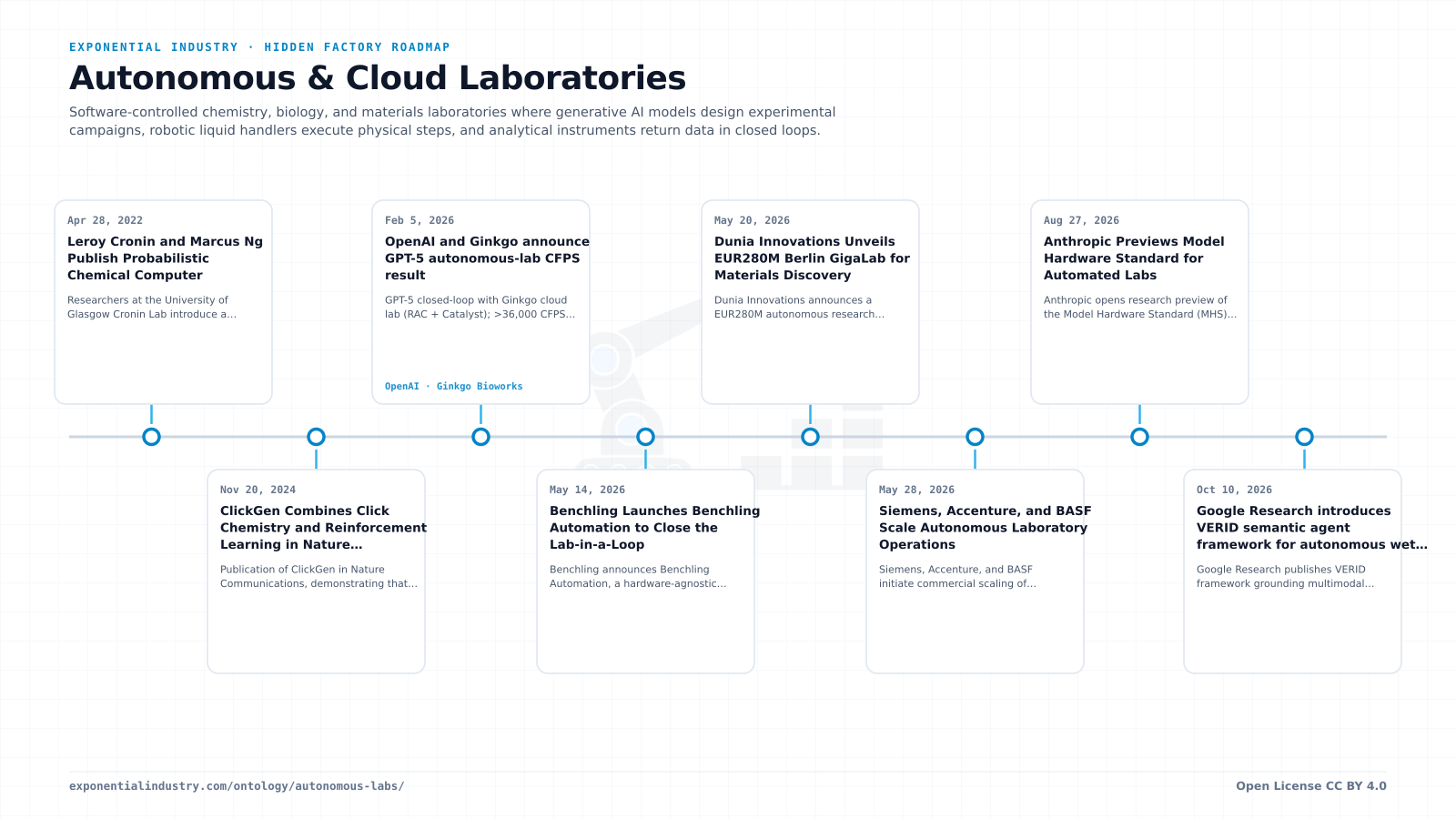
Google Research introduces VERID semantic agent framework for autonomous wet labs
Google Research publishes VERID framework grounding multimodal foundation models in formalized biological schemas and robotic wet-lab execution /Google Research Blog/.
Anthropic Previews Model Hardware Standard for Automated Labs
Anthropic opens research preview of the Model Hardware Standard (MHS) with HHMI Janelia, Genentech, and University of Washington Baker Lab, enabling AI agents to operate liquid handlers, plate readers, and microscopes safely.
Siemens, Accenture, and BASF Scale Autonomous Laboratory Operations
Siemens, Accenture, and BASF initiate commercial scaling of autonomous laboratory operations, moving past isolated 'robot in a corner' pilots to plant-wide orchestrated digital-twin lab environments /Siemens AG / Accenture / BASF/.
Dunia Innovations Unveils EUR280M Berlin GigaLab for Materials Discovery
Dunia Innovations announces a EUR280M autonomous research facility in Berlin in partnership with Siemens, ABB, NVIDIA, and AWS, industrializing the DMTA cycle for electrocatalysts and battery materials.
Benchling Launches Benchling Automation to Close the Lab-in-a-Loop
Benchling announces Benchling Automation, a hardware-agnostic laboratory data and execution layer connecting lab instruments directly to electronic notebooks and AI reasoning loops.
OpenAI and Ginkgo announce GPT-5 autonomous-lab CFPS result
GPT-5 closed-loop with Ginkgo cloud lab (RAC + Catalyst); >36,000 CFPS compositions, 580 plates, 40% protein-cost reduction ($422/g vs $698/g sfGFP). Closed-loop GPT-5 + Ginkgo cloud lab tested >36,000 CFPS compositions across 580 plates; $422/g sfGFP vs $698/g prior SOTA (40% reduction; 57% reagent-cost improvement per OpenAI) /OpenAI/ /PR Newswire / Ginkgo Bioworks/.
OpenAI and Ginkgo Bioworks Cut Cell-Free Protein Synthesis Cost by 40% with GPT-5
OpenAI and Ginkgo Bioworks deploy GPT-5 in a closed-loop cloud laboratory testing 36,000 reaction conditions, reducing cell-free protein synthesis cost by 40% ($698 to $422/g) and boosting yield by 27% /PR Newswire / Ginkgo Bioworks/.
ClickGen Combines Click Chemistry and Reinforcement Learning in Nature Communications
Publication of ClickGen in Nature Communications, demonstrating that modular reaction templates and reinforcement learning restrict generative molecular searches to synthesizable chemicals with validated PARP1 inhibitors.
Nobel Prize in Chemistry Awarded for Click Chemistry and Bioorthogonal Reactions
The Royal Swedish Academy of Sciences awards the 2022 Nobel Prize in Chemistry to Barry Sharpless, Morten Meldal, and Carolyn Bertozzi for developing modular click chemistry and bioorthogonal reactions that snap molecules together reliably.
Leroy Cronin and Marcus Ng Publish Probabilistic Chemical Computer
Researchers at the University of Glasgow Cronin Lab introduce a hybrid digital-chemical computing architecture utilizing chemical oscillators for algorithmic combinatorial optimization.
Core Architectures, Physical Parameters & Commercial Implementers
Our ontology tracks 14 primary architectures, hardware platforms, and material systems implementing Autonomous & Cloud Laboratories.
Trunk & Competing Technology Branches
Incumbent Trunks vs. Challenger & Emerging PathwaysAutomated Cloud Wet-Labs & Reconfigurable Bio-Foundries
High-throughput biological and analytical wet laboratories using modular robotic transport carts, acoustic liquid handlers, and programmatic LIMS execution for remote experiment orchestration.
TRL Grounding: TRL 9 commercial operations at Emerald Cloud Lab, Ginkgo Bioworks, Benchling, and HHMI Janelia.
Closed-Loop Robotic Materials Synthesis & Digital Chemputation Labs
Self-driving solid-state powder synthesis, electrocatalyst, and organic chemistry laboratories where active-learning foundation models direct robotic dosing, sintering, and characterization in a closed loop.
TRL Grounding: TRL 8 operational facilities at Periodic Labs, Dunia GigaLab, and Chemify Chemputation.
| Architecture / System | Class & TRL | Technical Mechanism & Specifications | Commercial Implementers & OEMs |
|---|---|---|---|
| GPT-5 | product · TRL 9 Commercial Scale | OpenAI frontier reasoning model. Used as the cognitive layer of a closed-loop autonomous lab with Ginkgo (2026-02-05). TRL 9 Grounding: OpenAI frontier model in production research use as of 2026-02-05 CFPS paper. | OpenAI |
| Benchling Automation
Implements: Automated Cloud Wet-Labs & Reconfigurable Bio-Foundries | product · TRL 9 Commercial Scale | Hardware-agnostic laboratory automation and data orchestration system developed by Benchling. Connects liquid handlers, automated plate readers, and robotic workcells directly to electronic lab notebooks and AI models to close the experimental design-make-test-analyze loop. TRL 9 Grounding: Commercial software system in general availability connecting laboratory instruments (Hamilton, Opentrons, HighRes, Automata) directly to enterprise digital records and AI feedback loops. | Benchling |
| Click Chemistry & Bioorthogonal Reactions | capability · TRL 9 Commercial Scale | Modular chemical philosophy and high-yield bioorthogonal reaction suite pioneered by Barry Sharpless, Morten Meldal, and Carolyn Bertozzi (Nobel Prize 2022). Snaps functional chemical building blocks together reliably without interfering with cellular biology, creating ideal modular constraints for AI-directed chemical synthesis. TRL 9 Grounding: Widely proven modular chemical synthesis paradigm utilized globally across commercial drug conjugation, antibody-drug conjugates (ADCs), and molecular biology. | Multiple OEMs |
| Ginkgo Bioworks Cloud Laboratory
Implements: Automated Cloud Wet-Labs & Reconfigurable Bio-Foundries | platform · TRL 8 First-of-a-Kind Qualified | Automated wet lab run remotely through software. Built from Reconfigurable Automation Carts (RAC) and Catalyst software; also offered as a cloud lab through Datapoints and Solutions. TRL 8 Grounding: In-house autonomous lab offered as a cloud lab via Datapoints/Solutions; executed 36,000 CFPS conditions in 2026 study. | Ginkgo Bioworks |
| Ginkgo Catalyst
Implements: Automated Cloud Wet-Labs & Reconfigurable Bio-Foundries | platform · TRL 8 First-of-a-Kind Qualified | Ginkgo automation software that specifies multi-instrument biological workflows for the RAC laboratory platform. TRL 8 Grounding: Automation software that translated GPT-5 designs into RAC workflows (Ginkgo 2026-02-05). | Ginkgo Bioworks |
| Anthropic Model Hardware Standard (MHS) | capability · TRL 5 Lab / Pouch Validation | Standardized hardware interface specification and driver protocol that enables AI models and autonomous agents to discover, operate, monitor, and troubleshoot physical laboratory instruments and robotic machinery safely. TRL 5 Grounding: Research preview deployed across partner biological and manufacturing laboratories (Janelia, Genentech, UW, CMU, QuEra) enabling AI agents to control instruments via driver-enforced safety limits. | Anthropic Deployed with: HHMI Janelia Research Campus |
| Dunia IRIS & Berlin GigaLab Platform
Implements: Closed-Loop Robotic Materials Synthesis & Digital Chemputation Labs | platform · TRL 7 Field Prototype | Autonomous materials discovery and self-driving laboratory platform developed by Dunia Innovations. Integrates the Intelligent Research and Innovation System (IRIS) with automated robotic workcells to close the Design-Make-Test-Analyze cycle for solid-state batteries, green hydrogen catalysts, and semiconductor materials. TRL 7 Grounding: Demonstrated operational prototype with proprietary IRIS platform in Berlin; €280M commercial GigaLab facility funded and in engineering execution with Siemens and ABB. | Dunia Innovations |
| VERID Semantic Lab Agent Architecture | product · TRL 5 Lab / Pouch Validation | Multi-agent cognitive architecture grounding LLM reasoning in formalized ontology, protocol validation, and laboratory instrumentation. TRL 5 Grounding: Demonstrated across simulated and physical bio-foundry workflows at Google Research. | Google DeepMind |
| Probabilistic Chemical Programmable Computer | capability · TRL 4 Lab / Pouch Validation | Hybrid digital-chemical computing architecture pioneered by Leroy Cronin and Marcus Ng. Employs coupled Belousov-Zhabotinsky oscillating chemical reaction networks under digital control to execute combinatorial optimization and computational tasks directly within fluid chemical media. TRL 4 Grounding: Validated in academic laboratory setup (arXiv:2204.13493) executing combinatorial state transitions and optimization algorithms via coupled oscillating chemical reaction networks. | Chemify |
| Chemify Chemputation Platform
Implements: Closed-Loop Robotic Materials Synthesis & Digital Chemputation Labs | platform · TRL 8 First-of-a-Kind Qualified | Robotic chemical synthesis and digital chemistry compiler turning molecular code into physical molecules through automated modular chemical reactors. TRL 8 Grounding: Platform deployed in commercial customer environments. | Chemify |
| Periodic Closed-Loop Autonomous Materials Synthesis Platform
Implements: Closed-Loop Robotic Materials Synthesis & Digital Chemputation Labs | platform · TRL 6 Pilot Line Validation | Fully automated robotic laboratory coupling solid-state precursor dispensing, high-temperature sintering furnaces, X-ray diffraction (XRD) characterization, and active learning algorithms for continuous autonomous materials exploration. TRL 6 Grounding: Operational in San Francisco lab facility running continuous automated synthesis iterations. | Periodic Labs Inc. |
| Aptamer Sandbox Closed-Loop Bio Engine | platform · TRL 5 Lab / Pouch Validation | Autonomous experimental platform integrating automated liquid handling, binding assays, and active learning models. TRL 5 Grounding: Validated in empirical wet-lab aptamer discovery iterations at Google Research. | Google DeepMind |
| ClickGen Generative Molecular Model
Implements: Closed-Loop Robotic Materials Synthesis & Digital Chemputation Labs | product · TRL 6 Pilot Line Validation | Reinforcement learning and deep generative model that constrains molecular design strictly to synthesizable chemical spaces using modular click-chemistry reaction templates. Resolves the synthesizability bottleneck in AI drug design through rapid, automated wet-lab validation. TRL 6 Grounding: Demonstrated full operational prototype in research laboratory environment (Nature Communications 2024) validating synthesized PARP1 inhibitor lead compounds in wet lab assays. | Multiple OEMs |
| Periodic Neon Foundation Model
Implements: Closed-Loop Robotic Materials Synthesis & Digital Chemputation Labs | platform · TRL 5 Lab / Pouch Validation | Trillion-parameter scientific foundation model trained on crystallographic, quantum chemical, and physical priors to predict novel crystal structures, phase stability, and synthetic recipes. TRL 5 Grounding: Trained on dedicated multi-thousand GPU cluster and integrated with Periodic Labs autonomous synthesis facility. | Periodic Labs Inc. |
Related Deep-Dive Engineering Analyses
Primary technical teardowns, unit-economics models, and supply-chain bottleneck analyses related to Autonomous & Cloud Laboratories.
Frequently Asked Questions
What is Autonomous & Cloud Laboratories and what industrial engineering problems does it address?
Software-controlled chemistry, biology, and materials laboratories where generative AI models design experimental campaigns, robotic liquid handlers execute physical steps, and analytical instruments return data in closed loops. Tracing from the empirical trial-and-error paradigm pioneered by Thomas Edison at Menlo Park, modern self-driving laboratories integrate open standards like Anthropic's Model Hardware Standard, Benchling Automation, and Siemens-BASF operations. Key commercial facilities include OpenAI and Ginkgo Bioworks' cell-free loops, Emerald Cloud Lab, and Dunia's €280M Berlin GigaLab.
What core technologies and manufacturing architectures comprise Autonomous & Cloud Laboratories?
Key technical architectures and manufacturing innovations include:
- Dunia IRIS & Berlin GigaLab Platform: Autonomous materials discovery and self-driving laboratory platform developed by Dunia Innovations. Integrates the Intelligent Research and Innovation System (IRIS) with automated robotic workcells to close the Design-Make-Test-Analyze cycle for solid-state batteries, green hydrogen catalysts, and semiconductor materials.
- Ginkgo Bioworks Cloud Laboratory: Automated wet lab run remotely through software. Built from Reconfigurable Automation Carts (RAC) and Catalyst software; also offered as a cloud lab through Datapoints and Solutions.
- GPT-5: OpenAI frontier reasoning model. Used as the cognitive layer of a closed-loop autonomous lab with Ginkgo (2026-02-05).
- Ginkgo Catalyst: Ginkgo automation software that specifies multi-instrument biological workflows for the RAC laboratory platform.
- Ginkgo Reconfigurable Automation Carts (RAC): Modular laboratory automation carts that execute liquid handling, incubation, and measurement in Ginkgo's cloud laboratory.
- Anthropic Model Hardware Standard (MHS): Standardized hardware interface specification and driver protocol that enables AI models and autonomous agents to discover, operate, monitor, and troubleshoot physical laboratory instruments and robotic machinery safely.
Which companies and industrial facilities lead deployment in Autonomous & Cloud Laboratories?
Leading industrial manufacturers, hyperscalers, and engineering operators include:
- Siemens AG: Dunia Innovations Unveils EUR280M Berlin GigaLab for Materials Discovery (May 20, 2026) — Dunia Innovations announces a EUR280M autonomous research facility in Berlin in partnership with Siemens, ABB, NVIDIA, and AWS, industrializing the DMTA cycle for electrocatalysts and battery materials.
- Benchling: Benchling Launches Benchling Automation to Close the Lab-in-a-Loop (May 14, 2026) — Benchling announces Benchling Automation, a hardware-agnostic laboratory data and execution layer connecting lab instruments directly to electronic notebooks and AI reasoning loops.
- Google DeepMind: Google Research introduces VERID semantic agent framework for autonomous wet labs (Oct 10, 2026) — We present foundational building blocks for autonomous wet laboratories, combining VERID digital twins, closed-loop aptamer sandboxes, and agent-guided epitope excision across biological workflows.
- Chemify: Leroy Cronin and Marcus Ng Publish Probabilistic Chemical Computer (Apr 28, 2022) — Researchers at the University of Glasgow Cronin Lab introduce a hybrid digital-chemical computing architecture utilizing chemical oscillators for algorithmic combinatorial optimization.
- Anthropic: Anthropic Previews Model Hardware Standard for Automated Labs (Aug 27, 2026) — Anthropic opens research preview of the Model Hardware Standard (MHS) with HHMI Janelia, Genentech, and University of Washington Baker Lab, enabling AI agents to operate liquid handlers, plate readers, and microscopes safely.
- Accenture: Siemens, Accenture, and BASF Scale Autonomous Laboratory Operations (May 28, 2026) — Siemens, Accenture, and BASF initiate commercial scaling of autonomous laboratory operations, moving past isolated robot-in-a-corner pilots to plant-wide orchestrated digital-twin lab environments.
What are key commercial projects and milestone achievements in Autonomous & Cloud Laboratories?
Major industrial breakthroughs and commercial milestones include:
- Leroy Cronin and Marcus Ng Publish Probabilistic Chemical Computer (Apr 28, 2022): Researchers at the University of Glasgow Cronin Lab introduce a hybrid digital-chemical computing architecture utilizing chemical oscillators for algorithmic combinatorial optimization.
- Benchling Launches Benchling Automation to Close the Lab-in-a-Loop (May 14, 2026): Benchling announces Benchling Automation, a hardware-agnostic laboratory data and execution layer connecting lab instruments directly to electronic notebooks and AI reasoning loops.
- Dunia Innovations Unveils EUR280M Berlin GigaLab for Materials Discovery (May 20, 2026): Dunia Innovations announces a EUR280M autonomous research facility in Berlin in partnership with Siemens, ABB, NVIDIA, and AWS, industrializing the DMTA cycle for electrocatalysts and battery materials.
- Siemens, Accenture, and BASF Scale Autonomous Laboratory Operations (May 28, 2026): Siemens, Accenture, and BASF initiate commercial scaling of autonomous laboratory operations, moving past isolated robot-in-a-corner pilots to plant-wide orchestrated digital-twin lab environments.
- Anthropic Previews Model Hardware Standard for Automated Labs (Aug 27, 2026): Anthropic opens research preview of the Model Hardware Standard (MHS) with HHMI Janelia, Genentech, and University of Washington Baker Lab, enabling AI agents to operate liquid handlers, plate readers, and microscopes safely.
- Google Research introduces VERID semantic agent framework for autonomous wet labs (Oct 10, 2026): We present foundational building blocks for autonomous wet laboratories, combining VERID digital twins, closed-loop aptamer sandboxes, and agent-guided epitope excision across biological workflows.
Related Technology Ontologies
Physical AI & Embodied Robotics
Artificial intelligence systems and autonomous machines that operate directly in and interact with the physical world, bridging bits to atoms. Spanning foundation models (Vision-Language-Action and World Foundation Models), physics-based simulation with synthetic data (Omniverse, Isaac Sim) to safely bridge Sim2Real, and embedded runtime computers (Jetson Thor, DRIVE AGX) executing closed-loop perception-action loops across humanoids, AMRs, adaptive manipulators, autonomous mobility, and smart spaces.
Data Center Power & Behind-the-Meter Generation
Behind-the-meter power generation and medium-voltage distribution architectures supply 100 MW to multi-gigawatt AI training campuses without waiting 5 to 8 years in utility transmission queues. Co-located energy parks pair aeroderivative natural gas turbines, solid-oxide fuel cells, or enhanced geothermal wells with 4-hour lithium iron phosphate (LFP) battery buffers to absorb millisecond GPU load steps. Inside the data hall, +/-400V and 800V DC busbars replace legacy 48V AC distribution to power 120 kW to 600 kW liquid-cooled racks from NVIDIA, Eaton, and Vertiv.
Rackscale AI Accelerators
Fully co-designed rack- and POD-scale AI systems that combine accelerators, host CPUs, scale-up fabric (NVLink-class domains), and scale-out networking in one thermal/mechanical package. Lineage runs from multi-GPU HGX/DGX boxes through Grace Hopper NVL32 domains to liquid-cooled 72-GPU racks (GB200, GB300, Vera Rubin) and competing racks such as AMD Helios. NVIDIA, AMD, and OEM rack builders (Dell, Supermicro) ship the current generation for AI-factory halls.