Aerospace Metallurgy, Superalloys & Advanced Foundry
- Exponential Industry
- 9 Milestones
Aerospace metallurgy and advanced foundry processes formulate nickel-, cobalt-, and iron-based superalloys and refractory metals that resist creep, oxidation, and hydrogen embrittlement above 1,100°C. Production routes combine vacuum induction melting (VIM), single-crystal directional solidification, hot isostatic pressing (HIP), and solid-state mechanical alloying to cast defect-free turbine blades and staged-combustion rocket injectors. Howmet Aerospace, Precision Castparts (PCC), ATI, SpaceX (SX500), and Foundation Alloy supply high-strength alloys for orbital propulsion and defense aviation.
Active Aerospace Metallurgy, Superalloys & Advanced Foundry Engineering Roles
Explore verified engineering requisitions ($135,000 – $235,000+) with unredacted direct apply URLs and verified corporate alumni networks on Scholar.


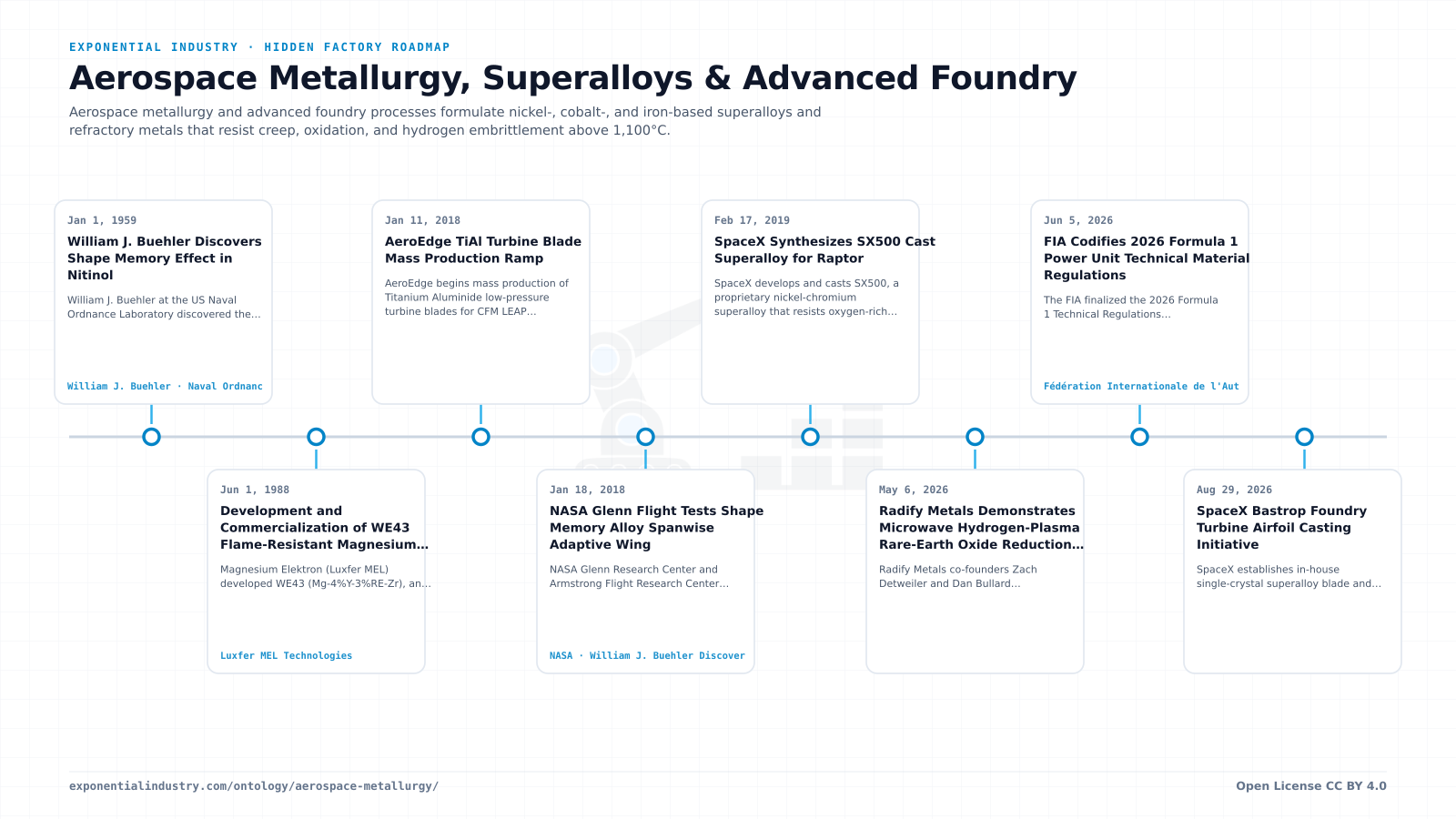
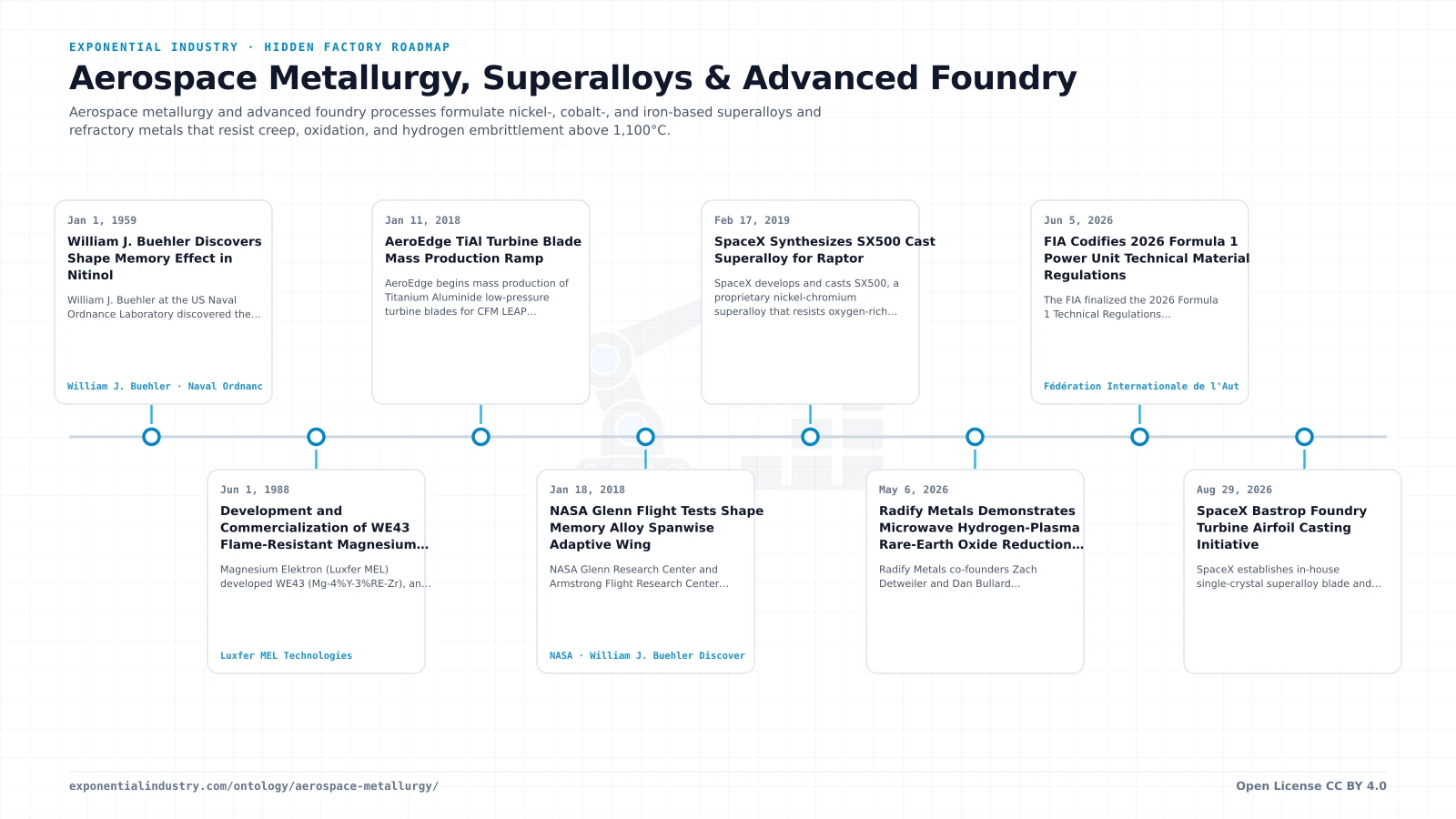
SpaceX Bastrop Foundry Turbine Airfoil Casting Initiative
SpaceX establishes in-house single-crystal superalloy blade and vane casting at Bastrop foundry to compress natural gas turbine supply lead times by 18 months for AI data centers /X/ /Tom's Hardware/ /The Information/.
FIA Codifies 2026 Formula 1 Power Unit Technical Material Regulations
The FIA finalized the 2026 Formula 1 Technical Regulations establishing permitted materials palettes and banning beryllium in AM, metal matrix composites, shape memory alloys (Nitinol), magnesium/tungsten alloys, and materials exceeding 18,400 kg/m3 density from Power Units /X/.
Radify Metals Demonstrates Microwave Hydrogen-Plasma Rare-Earth Oxide Reduction Reactor
Radify Metals co-founders Zach Detweiler and Dan Bullard demonstrated a compact microwave hydrogen-plasma reactor at Fort Mason in San Francisco on May 6, 2026 that strips oxygen from rare-earth and critical metal oxides with water vapor as the sole byproduct /YouTube (Founders, Inc.)/ /Radify Metals/.
SpaceX Synthesizes SX500 Cast Superalloy for Raptor
SpaceX develops and casts SX500, a proprietary nickel-chromium superalloy that resists oxygen-rich combustion gas corrosion at 300+ bar pressure inside Raptor rocket engines. /[SpaceX Propulsion Review](https://twitter.com /SpaceX Propulsion Review/.
NASA Glenn Flight Tests Shape Memory Alloy Spanwise Adaptive Wing
NASA Glenn Research Center and Armstrong Flight Research Center successfully flight-tested a subscale aircraft utilizing high-temperature shape memory alloy actuators to fold the outer wing section in flight without hydraulic actuators /NASA Glenn Research Center/.
AeroEdge TiAl Turbine Blade Mass Production Ramp
AeroEdge begins mass production of Titanium Aluminide low-pressure turbine blades for CFM LEAP aircraft engines utilizing Mitsui Seiki 5-axis machining centers /Mitsui Seiki/.
OSHA Enacts Comprehensive Occupational Beryllium Standard
The Occupational Safety and Health Administration (OSHA) published 29 CFR 1910.1024, slashing the 8-hour PEL for airborne beryllium to 0.2 µg/m³ to protect aerospace and industrial workers from Chronic Beryllium Disease /Occupational Safety and Health Administration (OSHA)/.
Development and Commercialization of WE43 Flame-Resistant Magnesium Alloy
Magnesium Elektron (Luxfer MEL) developed WE43 (Mg-4%Y-3%RE-Zr), an advanced rare-earth modified structural alloy delivering elevated temperature strength and high ignition resistance for aerospace gearboxes and cabin seat frames /Luxfer MEL Technologies/ /Federal Aviation Administration (FAA)/.
William J. Buehler Discovers Shape Memory Effect in Nitinol
William J. Buehler at the US Naval Ordnance Laboratory discovered the shape memory effect and superelasticity in equiatomic nickel-titanium (Nitinol), establishing the foundational metallurgy of solid-state active materials /Journal of Applied Physics/.
Core Architectures, Physical Parameters & Commercial Implementers
Our ontology tracks 14 primary architectures, hardware platforms, and material systems implementing Aerospace Metallurgy, Superalloys & Advanced Foundry.
Trunk & Competing Technology Branches
Incumbent Trunks vs. Challenger & Emerging PathwaysAerospace Precision Investment Casting
Precision lost-wax ceramic mold casting method for pouring complex titanium, aluminum, and nickel-base superalloy components with intricate internal geometry and thin walls for aircraft engines.
TRL Grounding: Standard manufacturing method for aerospace engine structural cases and turbine components.
Commercial Aircraft Teardown & Component MRO
Structured disassembly, nondestructive testing, ultrasonic inspection, and component recertification of commercial aviation airframes, jet engines, and landing gear systems into Used Serviceable Material (USM).
TRL Grounding: Certified FAA/EASA Part 145 repair stations and teardown operations processing commercial narrowbody and widebody airframes.
Ellwood City Forge 110,000-lb Open-Die & Contoured Eccentric Forgings
Heavy open-die press forging and multi-axis machining of concentric and eccentric contoured alloy steel and nickel-superalloy shafts up to 110,000 pounds.
TRL Grounding: Produces open-die alloy and nickel-superalloy forgings up to 110,000 lbs and 57 ft length in Ellwood City, Pennsylvania.
Graphicast ZA-12 Permanent Graphite Mold Precision Casting
Low-turbulence auto-fill permanent graphite mold casting process using high-strength ZA-12 zinc-aluminum alloy to produce near-net-shape structural parts.
TRL Grounding: Commercial near-net-shape ZA-12 zinc-aluminum casting system operating in Jaffrey, New Hampshire since 1978.
Ipsen TITAN Modular Vacuum Heat-Treating Furnace
High-uniformity horizontal and vertical vacuum heat-treating furnace system with automated thermal process control.
TRL Grounding: Flagship commercial vacuum heat-treating furnace family operating across aerospace, medical, and tool-steel thermal processing.
Nitrex Nitreg Potential-Controlled Gas Nitriding Process
Computer-controlled thermochemical gas nitriding and nitrocarburizing system regulating nitriding potential (Kn) to control white-layer and diffusion metallurgy.
TRL Grounding: Patented closed-loop Kn nitriding-potential control deployed across global automotive and aerospace gear and die heat treaters.
Solid-State / Advanced Metallurgy Platforms
Non-melt or advanced metal-making platforms (mechanical alloying, sintering, carbon-nanomaterial infusion) for higher-performance alloys.
TRL Grounding: Area: advanced metallurgy platforms in pilot/early industrial
Hertha Flex-HERS Continuous Pyrometallurgical Reactor
Continuous single-step pyrometallurgical reduction reactor producing molten steel and high-purity iron directly from unpelletized low-grade iron ore and fines.
TRL Grounding: Continuous pyrometallurgical reactor operating at demonstration scale in Conroe, TX with $65M DOD IBAS grant backing.
| Architecture / System | Class & TRL | Technical Mechanism & Specifications | Commercial Implementers & OEMs |
|---|---|---|---|
| Shape Memory Alloy Morphing & Solid-State Actuation
Implements: Solid-State / Advanced Metallurgy Platforms | material · TRL 9 Commercial Scale | Smart material systems utilizing thermoelastic martensitic-austenitic phase transformations in nickel-titanium (Nitinol) or high-temperature SMAs to enable reversible solid-state mechanical strain recovery, autonomous temperature-triggered valving, and adaptive aerodynamic morphing without hydraulics or electric motors. TRL 9 Grounding: Flight-proven in aerospace variable-geometry chevrons, spacecraft deployment mechanisms, autonomous thermal valves, and medical devices. | Naval Ordnance Laboratory, NASA |
| Mitsui Seiki Vertex 55X-II 5-Axis Machining Center | product · TRL 9 Commercial Scale | Ultra-high rigidity 5-axis vertical machining center engineered by Mitsui Seiki for hard-to-cut aerospace alloys and brittle intermetallic components. TRL 9 Grounding: Industrial machine tool in volume production, widely deployed for difficult-to-cut aerospace alloys. | Mitsui Seiki Kogyo Deployed with: AeroEdge |
| FIA 2026 Formula 1 Power Unit Technical Material Regulations | capability · TRL 9 Commercial Scale | Technical regulation framework establishing permitted materials palettes and banning beryllium in AM, metal matrix composites, shape memory alloys (Nitinol), magnesium/tungsten alloys, and materials with density over 18,400 kg/m3 within the F1 Power Unit perimeter. TRL 9 Grounding: Codified in FIA 2026 Formula 1 Technical Regulations (Articles 15.2-15.7) governing all 2026 power unit manufacturers. | Fédération Internationale de l'Automobile |
| Flame-Resistant Magnesium-Rare Earth Structural Alloys
Implements: Solid-State / Advanced Metallurgy Platforms | material · TRL 9 Commercial Scale | Ultra-low-density structural alloys (Mg-Y-Nd-Zr, such as Elektron 43 / WE43) engineered with rare-earth micro-alloying to elevate ignition temperatures, suppress combustible metal fires, and pass FAA and motorsport flammability standards while offering significant weight savings over aluminum and titanium. TRL 9 Grounding: Certified under FAA Aircraft Materials Fire Test Handbook Chapter 25 and widely utilized in helicopter transmissions and lightweight transport frames. | Luxfer MEL Technologies |
| Single-Crystal Superalloy Gas Turbine Airfoil Casting
Implements: Solid-State / Advanced Metallurgy Platforms | capability · TRL 9 Commercial Scale | Precision investment vacuum casting process producing single-crystal nickel-base superalloy blades and vanes with internal serpentine cooling channels to withstand turbine firing temperatures exceeding 1400°C. TRL 9 Grounding: Critical bottleneck component for aeroderivative and heavy-duty gas turbines; manufactured using directional solidification/single-crystal Bridgman vacuum casting. | SpaceX |
| Titanium Aluminide (TiAl) 5-Axis Turbine Blade Machining
Implements: Solid-State / Advanced Metallurgy Platforms | process · TRL 9 Commercial Scale | High-rigidity 5-axis milling methodology and customized tooling paths developed by AeroEdge for machining crack-sensitive intermetallic Titanium Aluminide (TiAl) LPT blades. TRL 9 Grounding: Mass-produced for CFM LEAP low-pressure turbine blades by AeroEdge using high-rigidity 5-axis centers. | AeroEdge |
| Beryllium & Al-Be Additive Manufacturing and Precision Optics | process · TRL 6 Pilot Line Validation | High-precision additive and powder metallurgy processing of pure beryllium and aluminum-beryllium alloys (AlBeMet AM162/AM140, Beralcast) delivering extreme specific stiffness and cryogenic dimensional stability for aerospace structures and space telescope optics, requiring strict containment against Chronic Beryllium Disease (CBD) toxicity. TRL 6 Grounding: Demonstrated on specialized laser powder bed fusion (L-PBF) and hot isostatic pressing (HIP) systems with closed glovebox atmospheric containment. | Materion |
| Radify Metals Microwave Hydrogen-Plasma Metal Oxide Reduction Reactor
Implements: Solid-State / Advanced Metallurgy Platforms | process · TRL 6 Pilot Line Validation | Compact reduced-pressure microwave plasma reactor that dissociates hydrogen gas into reactive atomic hydrogen radicals to strip oxygen from rare-earth oxides (dysprosium, samarium) and critical metal powders, yielding pure metal with water vapor as the sole byproduct. TRL 6 Grounding: Prototype reduced-pressure microwave hydrogen-plasma reactor demonstrated at Fort Mason in San Francisco reducing rare-earth and critical metal oxides into pure metals. | Radify Metals |
| Aerospace Precision Investment Casting | process · TRL 9 Commercial Scale | Precision lost-wax ceramic mold casting method for pouring complex titanium, aluminum, and nickel-base superalloy components with intricate internal geometry and thin walls for aircraft engines. TRL 9 Grounding: Standard manufacturing method for aerospace engine structural cases and turbine components. | Consolidated Precision Products |
| Commercial Aircraft Teardown & Component MRO | process · TRL 9 Commercial Scale | Structured disassembly, nondestructive testing, ultrasonic inspection, and component recertification of commercial aviation airframes, jet engines, and landing gear systems into Used Serviceable Material (USM). TRL 9 Grounding: Certified FAA/EASA Part 145 repair stations and teardown operations processing commercial narrowbody and widebody airframes. | Setna iO |
| Automated Kroll Titanium Sponge Reduction | process · TRL 7 Field Prototype | Modernized thermochemical reduction of titanium tetrachloride with molten magnesium, enhanced with automated process sensing and closed-loop recycling. TRL 7 Grounding: Commercial-scale front-end engineering design and pilot validation for domestic titanium sponge reduction. | American Advanced Materials |
| General Flash Solid-State Flash Electrolysis (SSFE)
Implements: Solid-State / Advanced Metallurgy Platforms | process · TRL 7 Field Prototype | Electric-field solid-state electrochemical refining converting refractory and rare-earth oxides directly into pure critical metals. TRL 7 Grounding: Operating 20 tpy Cambridge pilot near MIT converting metal oxides to semiconductor-grade critical metals without molten salts or halides. | General Flash, Inc. |
| Molten Oxide Electrolysis (MOE)
Implements: Solid-State / Advanced Metallurgy Platforms | process · TRL 7 Field Prototype | Direct electrochemical reduction of metal ores into pure metals and green steel using electricity. TRL 7 Grounding: Process validated in pilot plant and commercial-scale demonstration operations. | Boston Metal |
| OnodrimX Defense Hardware & Aerospace Manufacturing Stack | platform · TRL 7 Field Prototype | European precision manufacturing and OnodrimX defense engineering platform scaling industrial production across aviation, robotics, and energy systems. TRL 7 Grounding: Commercial industrial and defense hardware manufacturing capabilities funded with $300M Series A at $1.3B valuation across European sites. | Onodrim Industries |
Related Deep-Dive Engineering Analyses
Primary technical teardowns, unit-economics models, and supply-chain bottleneck analyses related to Aerospace Metallurgy, Superalloys & Advanced Foundry.
Frequently Asked Questions
What is Aerospace Metallurgy, Superalloys & Advanced Foundry and what industrial engineering problems does it address?
Aerospace metallurgy and advanced foundry processes formulate nickel-, cobalt-, and iron-based superalloys and refractory metals that resist creep, oxidation, and hydrogen embrittlement above 1,100°C. Production routes combine vacuum induction melting (VIM), single-crystal directional solidification, hot isostatic pressing (HIP), and solid-state mechanical alloying to cast defect-free turbine blades and staged-combustion rocket injectors. Howmet Aerospace, Precision Castparts (PCC), ATI, SpaceX (SX500), and Foundation Alloy supply high-strength alloys for orbital propulsion and defense aviation.
What core technologies and manufacturing architectures comprise Aerospace Metallurgy, Superalloys & Advanced Foundry?
Key technical architectures and manufacturing innovations include:
- Beryllium & Al-Be Additive Manufacturing and Precision Optics: High-precision additive and powder metallurgy processing of pure beryllium and aluminum-beryllium alloys (AlBeMet AM162/AM140, Beralcast) delivering extreme specific stiffness and cryogenic dimensional stability for aerospace structures and space telescope optics, requiring strict containment against Chronic Beryllium Disease (CBD) toxicity.
- Radify Metals Microwave Hydrogen-Plasma Metal Oxide Reduction Reactor: Compact reduced-pressure microwave plasma reactor that dissociates hydrogen gas into reactive atomic hydrogen radicals to strip oxygen from rare-earth oxides (dysprosium, samarium) and critical metal powders, yielding pure metal with water vapor as the sole byproduct.
- Titanium Aluminide (TiAl) 5-Axis Turbine Blade Machining: High-rigidity 5-axis milling methodology and customized tooling paths developed by AeroEdge for machining crack-sensitive intermetallic Titanium Aluminide (TiAl) LPT blades.
- Mitsui Seiki Vertex 55X-II 5-Axis Machining Center: Ultra-high rigidity 5-axis vertical machining center engineered by Mitsui Seiki for hard-to-cut aerospace alloys and brittle intermetallic components.
- Shape Memory Alloy Morphing & Solid-State Actuation: Smart material systems utilizing thermoelastic martensitic-austenitic phase transformations in nickel-titanium (Nitinol) or high-temperature SMAs to enable reversible solid-state mechanical strain recovery, autonomous temperature-triggered valving, and adaptive aerodynamic morphing without hydraulics or electric motors.
- Single-Crystal Superalloy Gas Turbine Airfoil Casting: Precision investment vacuum casting process producing single-crystal nickel-base superalloy blades and vanes with internal serpentine cooling channels to withstand turbine firing temperatures exceeding 1400°C.
Which companies and industrial facilities lead deployment in Aerospace Metallurgy, Superalloys & Advanced Foundry?
Leading industrial manufacturers, hyperscalers, and engineering operators include:
- AeroEdge: AeroEdge TiAl Turbine Blade Mass Production Ramp (Jan 11, 2018) — AeroEdge selected Mitsui Seiki Vertex 55X-II 5-axis vertical machining centers due to their extreme structural rigidity, enabling mass production of lightweight yet brittle Titanium Aluminide (TiAl) low-pressure turbine blades for the CFM LEAP engine.
- Luxfer MEL Technologies: Development and Commercialization of WE43 Flame-Resistant Magnesium Alloy (Jun 1, 1988) — Elektron 43 / WE43 is a high-strength magnesium casting and wrought alloy containing approximately 4% yttrium and 3% rare earths (neodymium/heavy rare earths) plus zirconium, designed for aerospace structural performance and high ignition resistance up to 300 degrees Celsius.
- SpaceX: SpaceX Bastrop Foundry Turbine Airfoil Casting Initiative (Aug 29, 2026) — Natural gas is necessary to supplement and bootstrap solar energy for several years. The primary limiting factor in gas turbines is casting blades and vanes; bringing single-crystal casting in-house at a new Bastrop foundry can accelerate gas turbine deployment by up to 18 months.
- Fédération Internationale de l'Automobile: FIA Codifies 2026 Formula 1 Power Unit Technical Material Regulations — 2026 F1 Technical Regulations ban specific high-performance materials from Power Units: (1) Beryllium in additive manufacturing and structural alloys; (2) Metal Matrix Composites (MMCs); (3) Shape memory alloys like Nitinol (to prevent passive aerodynamic morphing); (4) Magnesium and tungsten alloys due to fire risks; and (5) Materials with density exceeding 18,400 kg/m3 (eliminating osmium and iridium for mass concentration tricks).
- NASA: NASA Glenn Flight Tests Shape Memory Alloy Spanwise Adaptive Wing (Jan 18, 2018) — NASA Glenn Research Center developed high-temperature shape memory alloy (HTSMA) actuators and Nitinol components for adaptive aerodynamic wing trailing-edge morphing and variable-geometry engine chevrons, eliminating heavy hydraulic systems through solid-state thermal actuation.
- Naval Ordnance Laboratory: William J. Buehler Discovers Shape Memory Effect in Nitinol (Jan 1, 1959) — William J. Buehler and colleagues at the Naval Ordnance Laboratory discovered the shape memory effect and superelasticity in equiatomic nickel-titanium (Nitinol), demonstrating that solid-state diffusionless martensitic-austenitic phase transformations enable reversible mechanical strain recovery upon thermal cycling.
What are key commercial projects and milestone achievements in Aerospace Metallurgy, Superalloys & Advanced Foundry?
Major industrial breakthroughs and commercial milestones include:
- William J. Buehler Discovers Shape Memory Effect in Nitinol (Jan 1, 1959): William J. Buehler and colleagues at the Naval Ordnance Laboratory discovered the shape memory effect and superelasticity in equiatomic nickel-titanium (Nitinol), demonstrating that solid-state diffusionless martensitic-austenitic phase transformations enable reversible mechanical strain recovery upon thermal cycling.
- Development and Commercialization of WE43 Flame-Resistant Magnesium Alloy (Jun 1, 1988): Elektron 43 / WE43 is a high-strength magnesium casting and wrought alloy containing approximately 4% yttrium and 3% rare earths (neodymium/heavy rare earths) plus zirconium, designed for aerospace structural performance and high ignition resistance up to 300 degrees Celsius.
- AeroEdge TiAl Turbine Blade Mass Production Ramp (Jan 11, 2018): AeroEdge selected Mitsui Seiki Vertex 55X-II 5-axis vertical machining centers due to their extreme structural rigidity, enabling mass production of lightweight yet brittle Titanium Aluminide (TiAl) low-pressure turbine blades for the CFM LEAP engine.
- NASA Glenn Flight Tests Shape Memory Alloy Spanwise Adaptive Wing (Jan 18, 2018): NASA Glenn Research Center developed high-temperature shape memory alloy (HTSMA) actuators and Nitinol components for adaptive aerodynamic wing trailing-edge morphing and variable-geometry engine chevrons, eliminating heavy hydraulic systems through solid-state thermal actuation.
- FIA Codifies 2026 Formula 1 Power Unit Technical Material Regulations: 2026 F1 Technical Regulations ban specific high-performance materials from Power Units: (1) Beryllium in additive manufacturing and structural alloys; (2) Metal Matrix Composites (MMCs); (3) Shape memory alloys like Nitinol (to prevent passive aerodynamic morphing); (4) Magnesium and tungsten alloys due to fire risks; and (5) Materials with density exceeding 18,400 kg/m3 (eliminating osmium and iridium for mass concentration tricks).
- SpaceX Bastrop Foundry Turbine Airfoil Casting Initiative (Aug 29, 2026): Natural gas is necessary to supplement and bootstrap solar energy for several years. The primary limiting factor in gas turbines is casting blades and vanes; bringing single-crystal casting in-house at a new Bastrop foundry can accelerate gas turbine deployment by up to 18 months.
Related Technology Ontologies
Physical AI & Embodied Robotics
Artificial intelligence systems and autonomous machines that operate directly in and interact with the physical world, bridging bits to atoms. Spanning foundation models (Vision-Language-Action and World Foundation Models), physics-based simulation with synthetic data (Omniverse, Isaac Sim) to safely bridge Sim2Real, and embedded runtime computers (Jetson Thor, DRIVE AGX) executing closed-loop perception-action loops across humanoids, AMRs, adaptive manipulators, autonomous mobility, and smart spaces.
Data Center Power & Behind-the-Meter Generation
Behind-the-meter power generation and medium-voltage distribution architectures supply 100 MW to multi-gigawatt AI training campuses without waiting 5 to 8 years in utility transmission queues. Co-located energy parks pair aeroderivative natural gas turbines, solid-oxide fuel cells, or enhanced geothermal wells with 4-hour lithium iron phosphate (LFP) battery buffers to absorb millisecond GPU load steps. Inside the data hall, +/-400V and 800V DC busbars replace legacy 48V AC distribution to power 120 kW to 600 kW liquid-cooled racks from NVIDIA, Eaton, and Vertiv.
Rackscale AI Accelerators
Fully co-designed rack- and POD-scale AI systems that combine accelerators, host CPUs, scale-up fabric (NVLink-class domains), and scale-out networking in one thermal/mechanical package. Lineage runs from multi-GPU HGX/DGX boxes through Grace Hopper NVL32 domains to liquid-cooled 72-GPU racks (GB200, GB300, Vera Rubin) and competing racks such as AMD Helios. NVIDIA, AMD, and OEM rack builders (Dell, Supermicro) ship the current generation for AI-factory halls.